


Why a tip is not a strategy
A reader once emailed me asking for my “strategy” and then, in the same breath, asked who I fancied for the weekend. That contradiction sits at the heart of why most people lose, so I want to deal with it before anything else. A tip is a guess about one match. A strategy is a repeatable process for choosing and sizing bets that works across hundreds of matches whether any single one comes in or not. They are not the same thing and confusing them is expensive.
Here is a number that should reframe how you think about the whole exercise. Accumulators and parlays generate somewhere between sixty and seventy-five per cent of bookmaker revenue while accounting for only twenty-five to thirty-five per cent of the money staked. Read that again. The bets people make on impulse, the ones built from hope rather than process, are where the industry makes most of its profit. That is not a coincidence. It is the visible footprint of millions of bettors who have tips but no strategy, and it is the gap a disciplined approach is designed to climb out of.
I have spent the best part of a decade betting on Premier League and European football for real money, keeping records the whole way, and the single clearest lesson is this: your edge does not come from being a better forecaster than everyone else. It comes from a process the bookmaker cannot easily exploit. Disciplined selection, ruthless staking, honest record-keeping, and emotional control. None of it is exciting. All of it is what separates the people who are still betting profitably in five years from the people quietly topping up their accounts every month.
This article is the framework I actually use, stripped of mysticism. By the end you will understand what a real strategy contains, where a genuine edge can come from, how to size your bets so variance does not wipe you out, and how to measure whether any of it is working. It will not tell you who to back on Saturday. That is the point.
What actually counts as a strategy
Strip away the marketing and a betting strategy is a set of rules you follow regardless of how you feel, and the “regardless of how you feel” part is the whole game. Anyone can have rules on a calm Tuesday. The strategy is what survives a Saturday where you have lost four bets in a row and your gut is screaming at you to chase.
A complete strategy answers four questions before you place a single bet. What types of bets and markets am I betting, and which am I refusing to touch? How do I decide a bet qualifies, in concrete terms I could explain to someone else? How much do I stake, and how is that figure calculated rather than felt? And how do I record and review what happened so the strategy improves rather than ossifies? If you cannot answer all four in writing, you do not have a strategy, you have a collection of habits, and habits drift under pressure.
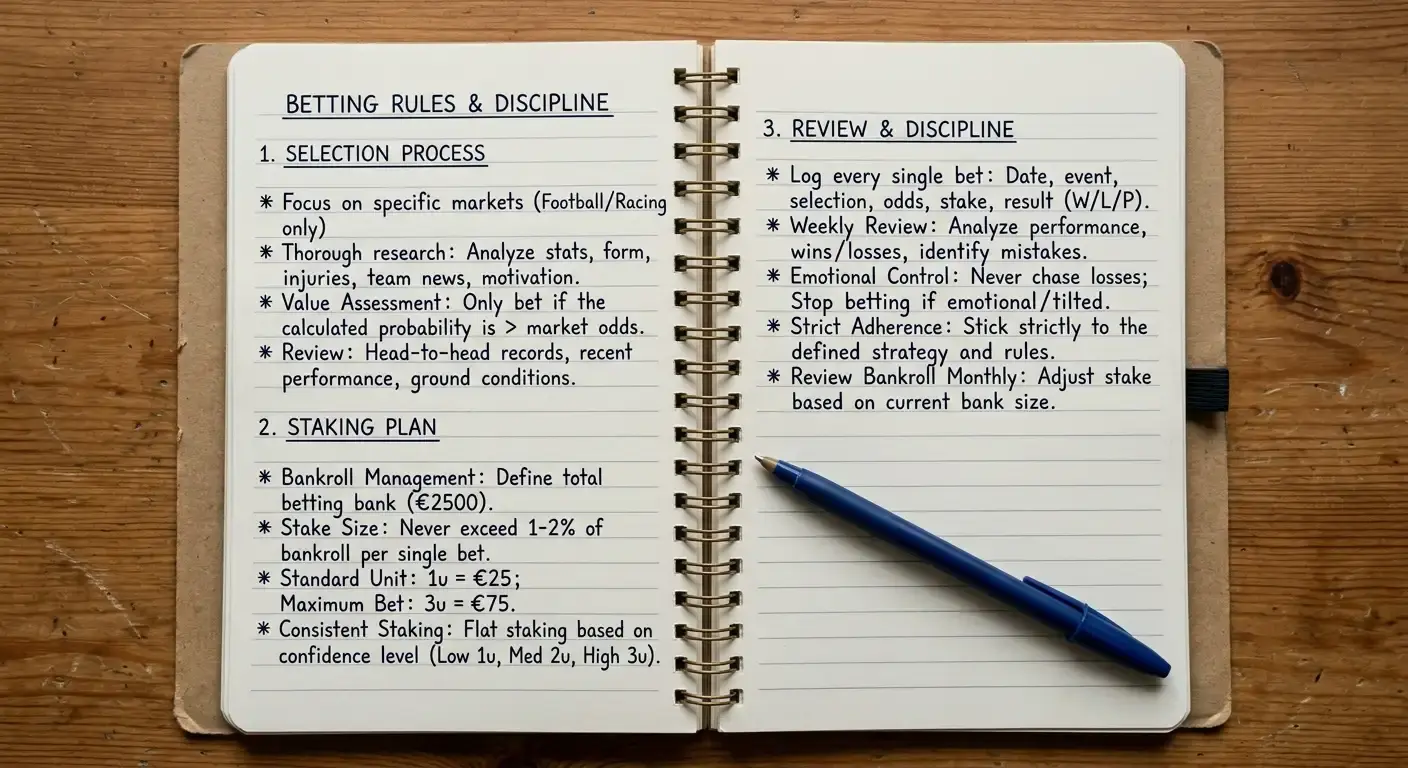
The refusing part deserves emphasis because beginners always want to add bets, never subtract them. A good strategy is mostly a list of bets you will not make. I do not bet markets I cannot price, I do not bet leagues I do not watch, and I do not bet because it is the weekend and there is football on. Those three refusals alone eliminate the bulk of the impulsive volume that feeds bookmaker margins. Constraint is not a limitation on a strategy. Constraint is the strategy.
There is a useful distinction here between a system and a strategy, because the words get used loosely. A system is a mechanical rule, “back the draw when two defensive sides meet”, that you could automate. A strategy is the broader judgement framework that decides whether a system is worth running, how much to risk on it, and when to abandon it. Systems can be part of a strategy, but a system on its own, with no staking discipline or review behind it, is just a tip generator with extra steps. The framework is what matters, and the framework is what I will keep returning to.
Finding an edge that survives contact
The hardest truth in betting is that European football carries the deepest, sharpest markets in the world, and that is precisely why finding an edge there is so difficult. Soccer generates well over forty per cent of all global online sports betting revenue, which means the biggest, most sophisticated trading operations on the planet are pricing the matches you want to bet. You are not up against a friendly local bookie. You are up against models that have eaten more data than you will ever see.
So where can an ordinary bettor find a genuine edge? Not in the headline markets of the biggest matches, where the prices are razor sharp and shopping for an extra tenth of a point is the only realistic gain. The edge lives in the corners the big models pay less attention to: lower leagues with thinner liquidity, niche markets like corners and bookings, early-week prices before the sharp money arrives, and specific situations you understand better than a generalist algorithm because you watch the football and the model only reads the numbers.
An edge has to be defined before it can be exploited, and “I think they will win” is not a definition. A real edge is a repeatable reason to believe the true probability of an outcome differs from the bookmaker’s implied probability, in a direction and by a margin you can articulate. Maybe you have noticed a promoted side is being systematically underpriced because the market has not updated to their improved squad. Maybe you track a referee whose card averages the market consistently misjudges. The specifics vary. The structure never does: a measurable gap between your probability and the price, found in a place the sharp money has not yet closed.

This is where strategy connects to the mechanics of pricing, and you cannot find an edge without being able to read what the odds are telling you. Quantifying that gap, turning a hunch into a probability and comparing it against the price, is its own discipline, and I have set out the full method in my guide to finding positive expected value in football. For now, hold onto the principle: an edge you cannot measure is an edge you cannot trust, and an edge you cannot trust will not survive a bad month.
One warning that has saved me real money. Most apparent edges are not edges at all, they are small samples flattering a strategy that will revert to the mean the moment you scale it up. The market is efficient enough that genuine, durable edges are rare and small. If you think you have found a way to win twenty per cent on turnover, you have almost certainly found a fluke or a mistake in your own record-keeping. Real edges are measured in low single digits, and the people who make money do so by applying a small edge relentlessly, not by chasing a fantasy of a large one.
Staking discipline: the part that actually keeps you alive
Ask me what separates the bettors who survive from the ones who blow up, and I will not say selection. I will say staking. I have watched people with genuinely good selection skills destroy their accounts because they bet five per cent of their bankroll on a “certainty” and ten per cent on a “lock”, and I have watched mediocre tipsters last for years because they never risked more than they could afford to lose on a single bet. Staking is the difference between a bad week and a catastrophe.
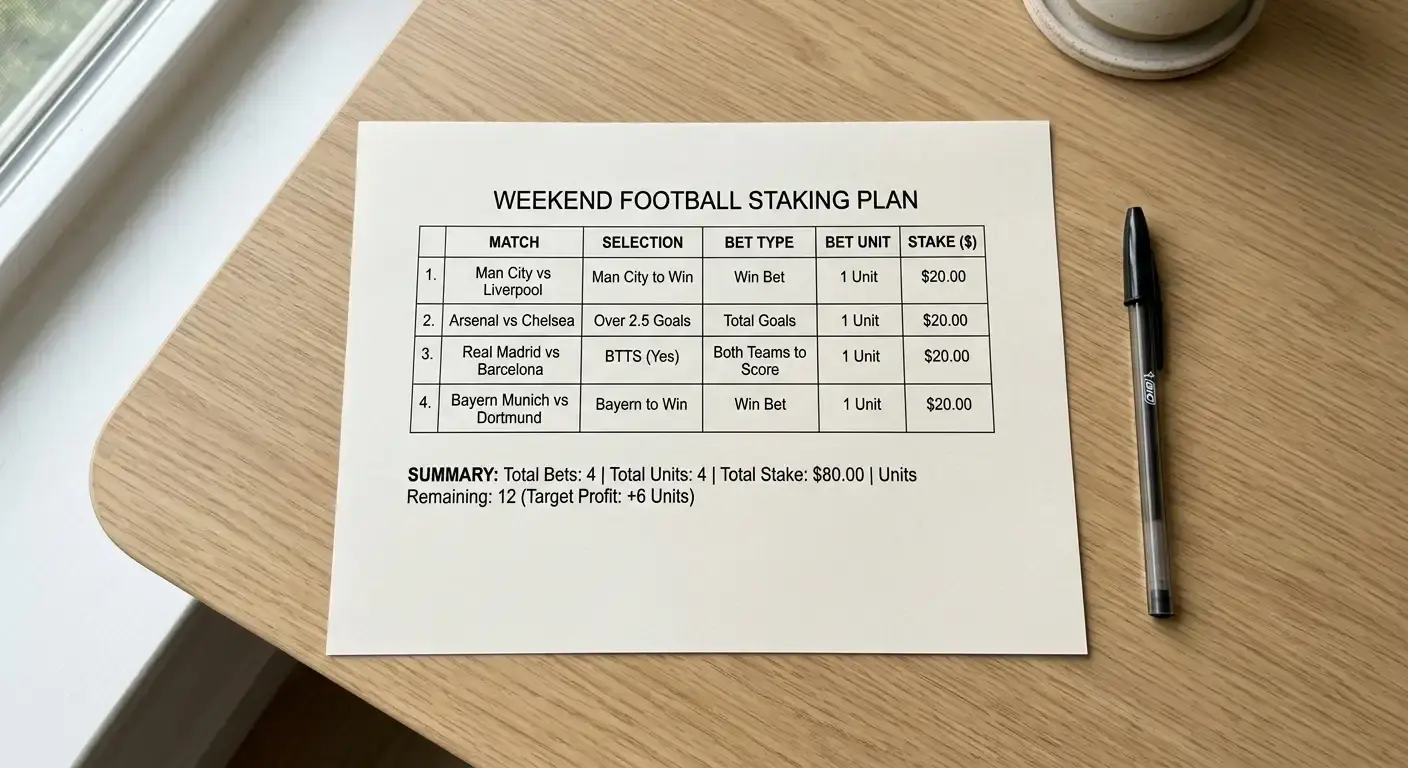
The foundation is the unit. A unit is a fixed fraction of your total betting bankroll, typically one to two per cent, and it is the amount you stake on a standard bet. If your bankroll is 1,000 pound and your unit is one per cent, you are betting 10 pound. The power of the unit is that it scales automatically: as your bankroll grows, your stakes grow with it, and as it shrinks, your stakes shrink, which means a losing run cannot accelerate into ruin because each bet is always sized to what you currently have rather than what you had at your peak.
Flat staking, where every bet is the same number of units regardless of how confident you feel, is the approach I recommend to almost everyone, and I say that having tried the alternatives. The temptation is to bet more on your strong fancies, but the data on human confidence is brutal: we are systematically overconfident, and the bets we feel surest about are not reliably more likely to win. Flat staking removes that flawed self-assessment from the equation. It is boring, it feels mechanical, and it is exactly why it works. The full mechanics of sizing units, handling losing runs, and comparing staking plans deserve their own treatment that goes deeper than I can here, but the principle to hold onto is that a stake you calculate will always serve you better than a stake you feel.
The cardinal sin, the one that ends more betting careers than any other, is the progression, and chasing in particular. Doubling your stake after a loss to “win it back” feels logical and is mathematically suicidal, because a run of losses long enough to bankrupt you is not just possible, it is statistically guaranteed if you bet long enough. The bookmaker margins have been climbing for years, with average US hold rates rising from 6.7 per cent in 2018 to 10.15 per cent by 2025, which means the mountain you are trying to climb back up after a loss is steeper than it was a decade ago. Chasing throws you off it. Flat staking keeps you on the path.
There is a deeper point hiding in all this. Staking discipline is really emotional discipline wearing a number. The reason flat staking works is not the arithmetic, it is that it removes the moments where emotion would otherwise dictate the size of your risk. Every staking decision you make in the heat of a losing Saturday is a decision you will make badly. The strategy is to make those decisions in advance, in writing, on a calm day, and then simply follow them.
Record-keeping and the closing line
The first time I went back through a full season of my own bets, properly logged, I discovered that a market I was certain I was good at had quietly lost me money for months. Without the record I would have carried on. That is the entire case for record-keeping in one sentence: you cannot improve what you do not measure, and your memory is a liar that remembers your wins and forgets your losses.
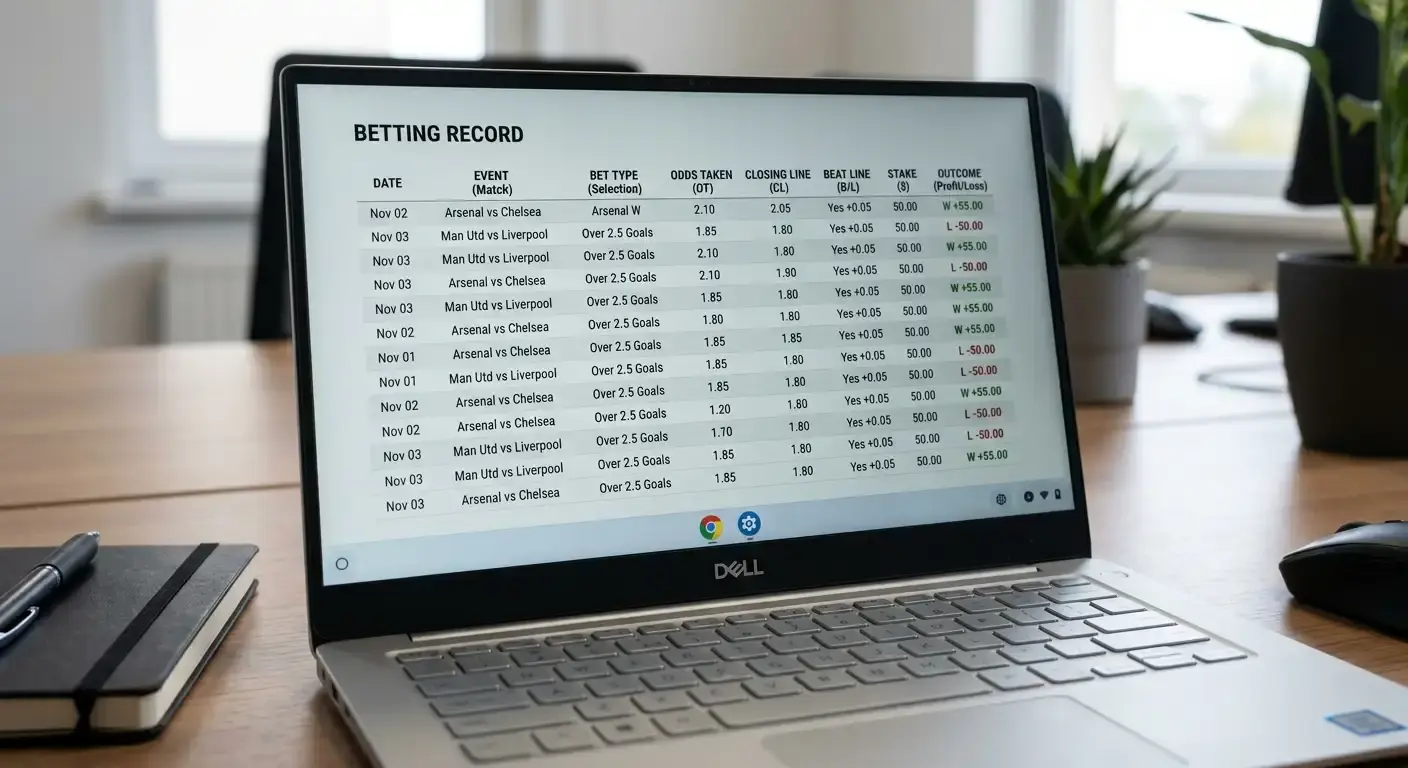
A useful betting record captures more than win or lose. For every bet I log the date, the match, the market, the selection, the odds I took, my stake in units, the result, and the closing odds, which is the price that market settled at just before kick-off. Most of those fields are obvious. The last one, the closing line, is the secret weapon, and almost no recreational bettor tracks it.
Closing line value, usually shortened to CLV, is the difference between the price you took and the price the market closed at. If you backed a team at 2.50 and the price drifted in to 2.20 by kick-off, you beat the closing line, because the market moved in your direction after you bet. Over a large sample, consistently beating the closing line is the single most reliable indicator that you are actually finding value rather than getting lucky, because the closing price is the market’s most accurate estimate of true probability after all the sharp money has had its say. You can win bets and have terrible CLV, which means you are getting lucky and will eventually regress. You can lose bets and have excellent CLV, which means you are betting well and the results will catch up.
This is why I tell people to judge their betting by CLV long before they judge it by profit. Profit over a few hundred bets is mostly noise. Variance in football is enormous, and a good bettor can be down over a season while a bad one is up. But CLV is signal. If you are consistently beating the closing line, the process is sound and the money will follow given enough time. If you are consistently behind it, no amount of short-term profit should reassure you, because you are on the wrong side of the market’s own verdict and the maths will eventually collect.
Keeping this record is tedious and that is the point. The tedium is a filter. The bettors willing to log every bet honestly, including the ones they would rather forget, are the same bettors with the discipline to follow a staking plan and refuse a bad bet. The spreadsheet is not just a measurement tool. It is a daily reminder that you are running a process, not chasing a feeling.
Specialise or spread your attention
Here is a debate I have had with serious bettors for years, and there is no clean answer, only a real trade-off. Do you specialise deeply in one league or market, or do you spread across many to find more opportunities? Both work, and both fail, depending on the bettor, and understanding the trade-off matters more than picking a side.
The case for specialisation is sharpness. Fifteen per cent of UK men place sports bets compared with four per cent of women, and within that betting population the people who make money are overwhelmingly those who know something specific extremely well rather than something general vaguely. If you watch every match in a particular league, track the squads, understand the managers and the referees, you develop a feel that a generalist model cannot replicate, and that feel is your edge. The narrower your focus, the deeper your knowledge, and the more reliably you can spot when the market has mispriced something you understand.
The case against is opportunity. A single league only throws up so many genuine value bets, and if you are disciplined enough to bet only those, you may go weeks with nothing to do, which most people cannot tolerate. Spreading across leagues and markets means more bets pass your filter, which keeps your bankroll working and your sample size growing. The danger is obvious: spread too thin and you are betting markets you do not really understand, which is just impulsive volume in a respectable disguise.
My own resolution, for what it is worth, is to specialise in depth but allow a small, ring-fenced portion of my betting for opportunistic value in markets I understand well enough even if I do not follow them daily. The bulk of my edge comes from the leagues I know inside out. The supplementary bets keep the bankroll active without diluting the core. Whatever you choose, choose it deliberately and write it into your strategy, because the bettor who drifts between specialising and spreading without deciding ends up doing neither well.

Psychology, tilt and the marketing aimed at you
The most dangerous opponent you will face is not the bookmaker. It is yourself on a bad afternoon, and the gambling industry knows this far better than you do. Young men aged eighteen to thirty-four show the highest prevalence of problem betting at 13.4 per cent, and that demographic is targeted by an apparatus of marketing specifically engineered to override exactly the discipline this article is trying to instil.
Tilt is the term, borrowed from poker, for the emotional state where you abandon your strategy and bet on feeling. It comes after a bad beat, a last-minute goal that flips a winning bet into a loss, and it whispers that you can fix the pain immediately if you just place one more, bigger bet. Tilt is not a character flaw, it is a predictable human response to loss, and the only reliable defence against a predictable response is a rule made in advance. My rule is simple and absolute: I do not place a bet within an hour of a loss that hurt. The cooling-off period is not optional and it is not negotiable, because the version of me that wants to bet in that hour is not the version I trust with money.
The marketing dimension deserves a harder look than most betting guides give it, because the same gamification that makes apps engaging is engineered to erode discipline. Keith Whyte, who spent years leading work on problem gambling in the United States, put the long-term answer plainly: “Teaching this next generation of kids how to make more informed choices, how to think critically about the marketing of everything that’s gamified, has got to be the solution.” That critical thinking is not just a public health goal, it is a personal edge. Every push notification offering you a “boosted” price, every “bet now” prompt during a live match, every same-game multi the app suggests, is designed to make you bet faster and more often than your strategy would allow. Recognising the prompt as a prompt is half the battle.
The practical defences are unglamorous and they work. Turn off marketing notifications entirely. Set deposit limits at a level your calm self chooses, so your tilted self cannot top up. Bet from a separate, ring-fenced bankroll you have mentally written off as the cost of the hobby. And keep that record, because nothing cools a tilt faster than looking at the honest, logged consequences of the last time you let one drive your stakes. Discipline is not a feeling you summon in the moment. It is a structure you build when calm so that the moment cannot reach your money.

A monthly routine that holds it together
Everything above is theory until it lives in a routine, so here is the rhythm I actually run, monthly rather than daily, because daily is where obsession and tilt breed. At the start of the month I confirm my bankroll figure and recalculate my unit from it, which automatically adjusts my stakes up or down based on the previous month’s results. No drama, no decision, just arithmetic.
Through the month I bet only what passes my filter, log every bet the moment I place it, and refuse to look at running profit, because running profit in a small sample is noise that triggers exactly the emotional responses I am trying to avoid. The bets either qualify or they do not. The stake is either the unit or it is not. There is very little to decide in the heat of the moment, which is the whole design.
At the end of the month I review. Not the profit first, the closing line value first. Am I beating the closing line across my bets? If yes, the process is sound regardless of what the profit says, and I continue unchanged. If no, something in my selection is off and I investigate before I bet another pound. Then I look at the markets and leagues individually, hunting for the quiet losers my memory would otherwise protect, the way that defensive-derby market I was so sure of turned out to be bleeding me dry. The review is where the strategy improves, and a strategy that does not improve is just a habit waiting to fail.
The monthly cadence matters more than it sounds. Football betting punishes the impatient brutally, and the rhythm of check-bet-log-review, repeated month after month, is what converts a collection of good intentions into an actual edge. It is slow. It is unexciting. It is the closest thing to a secret that exists in this game, which is to say it is no secret at all, just discipline that most people are unwilling to sustain.
The long game is the only game
If you take one thing from all of this, take the timescale. A football betting strategy is not judged on a weekend or even a month. It is judged on hundreds of bets, measured by closing line value before profit, sustained by a unit that scales itself and a record that refuses to flatter you. The bettors who win are not cleverer forecasters. They are more disciplined operators of an unglamorous process, applied relentlessly while everyone around them chases the last-minute equaliser that flipped their acca.
The bookmaker is not trying to beat you on Saturday. The bookmaker is running percentages over millions of bets and waiting for your discipline to crack. Your strategy is the structure that stops it cracking. Build it on a calm day, write it down, follow it when you do not feel like it, and review it honestly. Do that, and you have given yourself the only realistic chance there is. Skip it, and you become part of the sixty to seventy-five per cent of revenue that funds the whole machine.
