

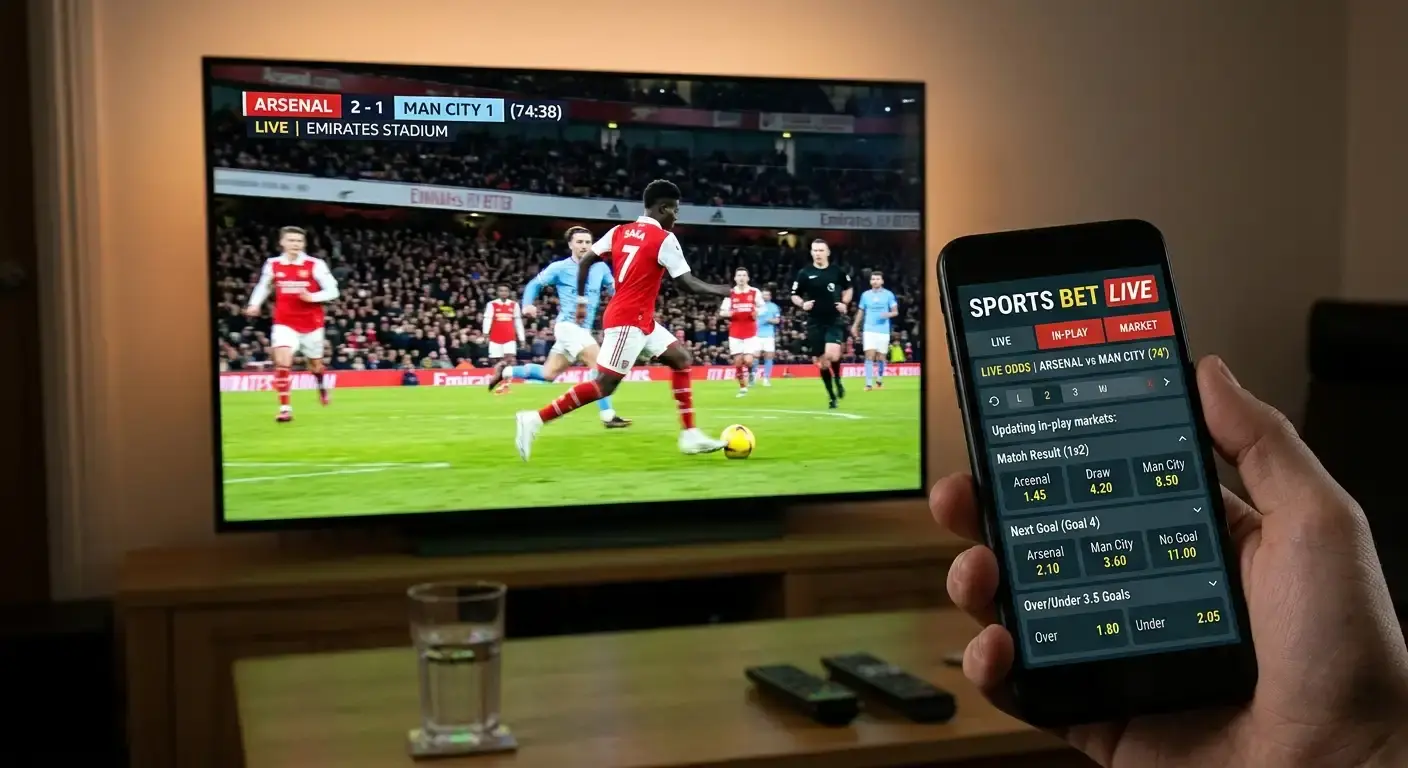
The bet that never sits still
The first time I traded a match in-play properly, I backed the underdog at half-time, watched them equalise eight minutes later, and saw my potential return halve before I could even decide whether to take it. That is in-play betting in a single sentence: a market that re-prices itself second by second while you make decisions under pressure, and one that has quietly become the dominant way Britain bets on football.
The scale is staggering and most casual bettors have not registered it. Live and in-play betting now accounts for 53.4 per cent of all online betting activity, more than half of everything staked online, and it is projected to keep growing at nearly fifteen per cent a year through to 2031. Live football is the single most popular live-betting format in Britain, with around five per cent of all adults and nine per cent of men placing live football bets. The pre-match coupon you grew up with is no longer where the action is. The action is in the seventy-plus minutes after kick-off, on a screen that will not stop moving.
Pre-match betting and in-play betting feel similar but they are fundamentally different animals. Pre-match, you study at your leisure, the price sits still, and you commit when ready. In-play, the price is a living thing reacting to every shot, every substitution, every minute that ticks off the clock without a goal, and you are competing not just against the bookmaker’s model but against the clock and your own adrenaline. Understanding how that re-pricing works, and where it goes wrong, is the entire skill.
Across this article I will show you how live odds actually update, which in-play markets are worth your attention, how to read the momentum of a match without being fooled by it, why markets suspend at the worst possible moments, and how to keep your discipline intact when everything about the live experience is engineered to make you bet faster than you should.
How live odds update
The core thing to grasp is that an in-play price is a continuously recalculated estimate of probability, and the two biggest inputs are the score and the clock. A pre-match price is a snapshot. An in-play price is a film, and every frame is a fresh calculation of how likely each outcome is given everything that has happened up to this exact second.
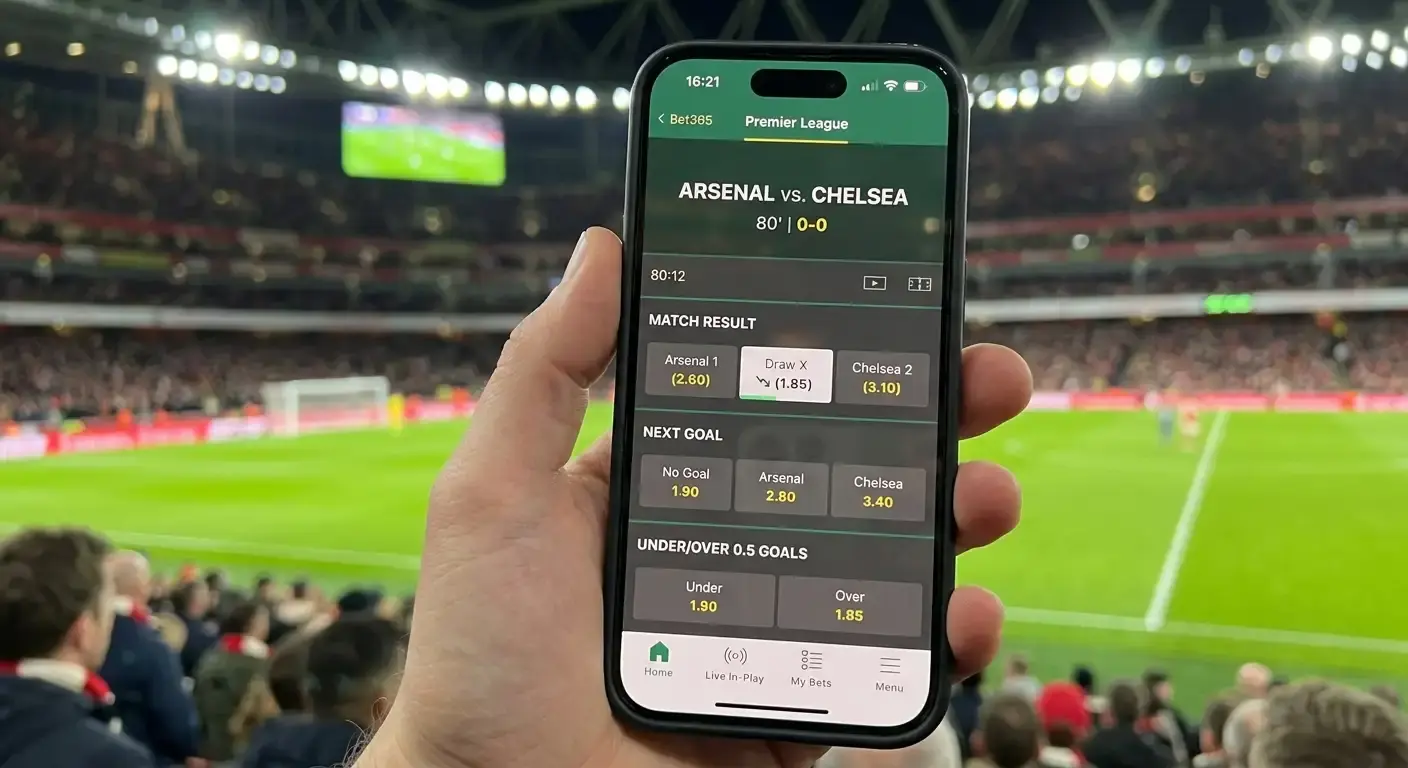
Start with the most powerful variable, which is time. Imagine a match level at 0-0. Before kick-off, the draw might be priced around 3.40. As the goalless minutes accumulate with no breakthrough, the probability of the match ending as a draw steadily rises, because there is less and less time left for either side to score, so the draw price steadily shortens. By the eightieth minute of a 0-0, the draw might be trading at 2.00 or shorter. Nothing has happened, and yet the price has moved enormously, purely because time has passed. The clock alone re-prices the entire match, every second, in the background.
Then layer on events. A goal is the obvious one, and it detonates the prices: the moment a team scores, their win probability leaps, the opposition’s collapses, and the over or under goal markets lurch accordingly. But goals are not the only inputs. A red card shifts the balance for the rest of the match. A penalty awarded but not yet taken sends the markets into a frenzy of recalculation. A key striker substituted off changes the model’s estimate of how dangerous a side remains. The in-play model is digesting all of this and spitting out new prices faster than any human could.
What you are really competing against here is a sophisticated automated trader, and that is a humbling thing to internalise. The bookmaker’s in-play model has seen vastly more matches than you have and reacts in milliseconds. Your edge, if you have one, cannot come from reacting faster, because you will always lose that race. It can only come from judgement the model lacks: a read on the texture of a specific match, an understanding that this particular team always pushes for a late goal, a sense that the momentum on screen is misleading. The price moves on data. You profit, if at all, on interpretation.
Popular in-play markets
Not every market suits live betting, and knowing which ones do is half the battle. The markets that work in-play are the ones where the live situation gives you genuine, readable information that the pre-match price could not have captured, rather than the ones where you are just guessing faster.
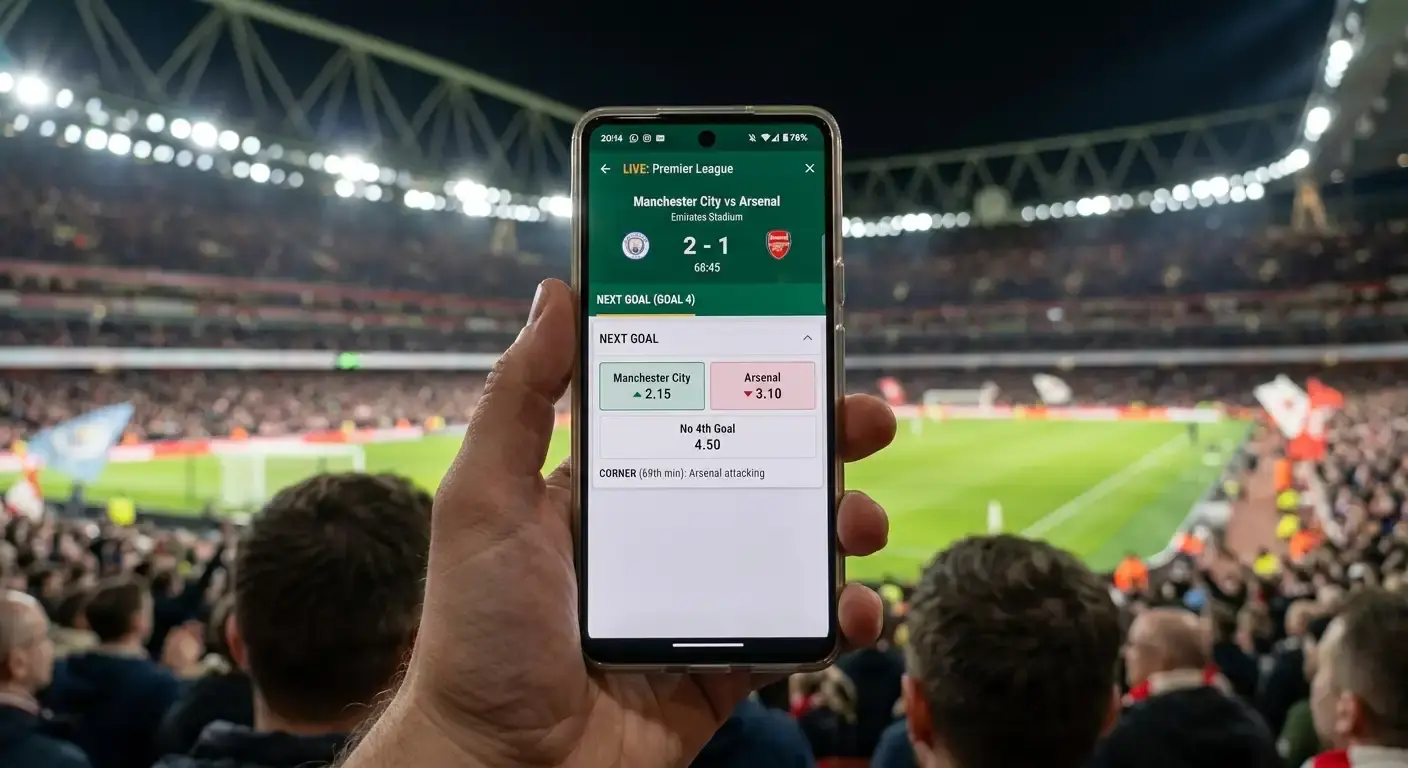
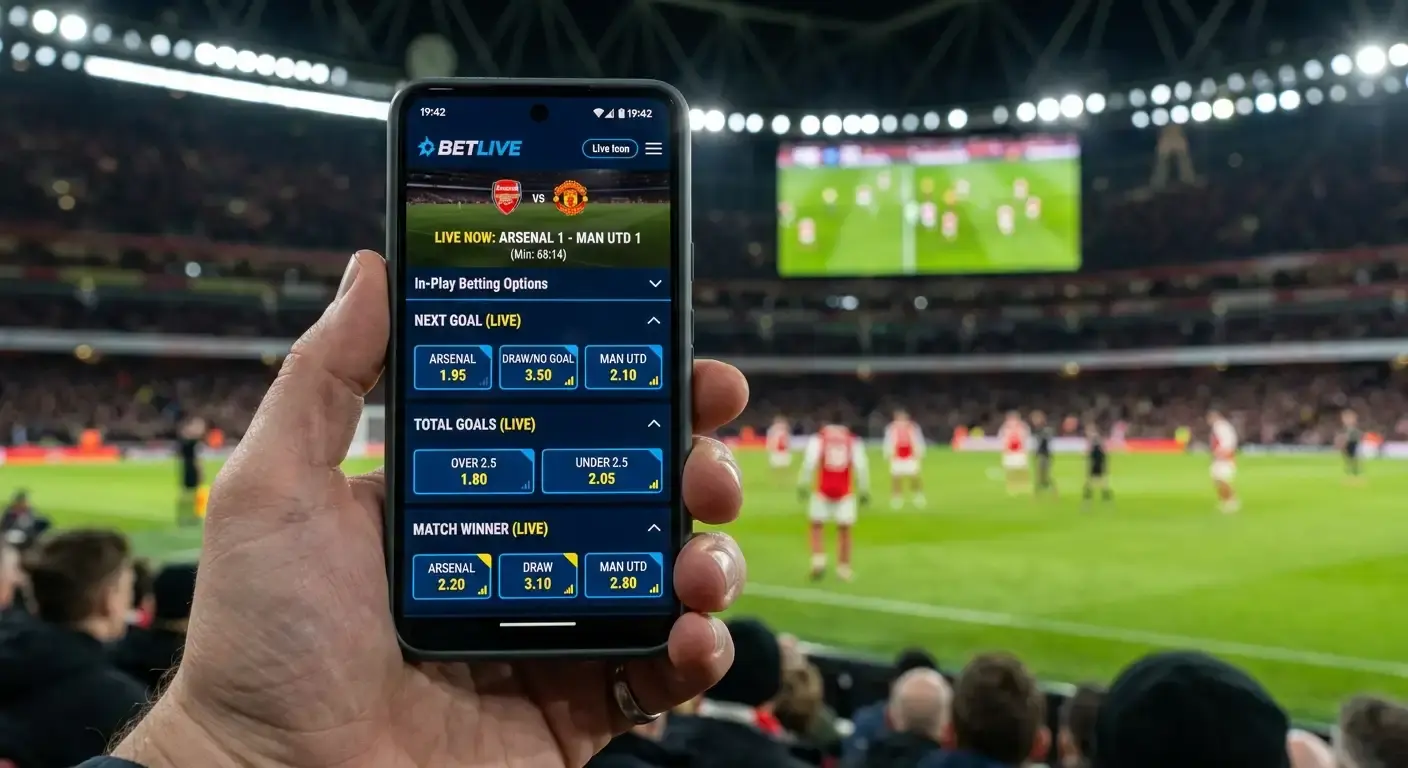
The next goal market is the purest in-play bet and my usual starting point for explaining the format. It asks one question: which team scores next, or will there be no further goal? It re-prices constantly with momentum and time, and it suits in-play perfectly because you can watch the run of play and form a view the pre-match market never had access to. A side camped in the opposition half, winning corner after corner, will see their next-goal price shorten, and if you genuinely believe the pressure is about to tell, that is a readable edge. The match-result market in-play is the same idea on a larger canvas, re-pricing the home, draw and away outcomes as the game develops.
Over and under goals markets come alive in-play in a particular way. A match that is 0-0 at half-time has dramatically changed the live over 2.5 goals price, because half the match has gone with no goals, so the probability of three or more arriving has dropped and the under has shortened. If you watch a first half and conclude that both sides are far more dangerous than the cagey opening suggested, the live overs price may now offer value the half-time scoreline has artificially inflated. This is the kind of read that rewards actually watching rather than just staring at numbers.
Then there are the in-play specials and the live bet builders, which the apps push hardest because they are the most profitable. Live correct score, live first or next goalscorer, live same-game multis assembled mid-match. These markets are exciting and they carry fat margins, the same compounding edge that makes their pre-match cousins so lucrative for the bookmaker. My advice is the same as it is for any high-margin product: enjoy them as entertainment with a known cost, but understand that the next-goal and match-result markets, where the margin is thinner and the information clearer, are where any genuine in-play edge actually lives.
Reading match momentum without being fooled
Momentum is the most seductive and most dangerous concept in live betting, and I have lost money to it more times than I have made money from it. The eye sees a team attacking, the body feels the inevitability of a goal, and the finger reaches for the next-goal bet. Sometimes the goal comes. Often it does not, and the team that has been “all over” the opposition concedes on the break against the run of play, because football is cruel and momentum is not a law of physics.
The trap is that momentum feels predictive when it is mostly descriptive. A side dominating possession and territory is more likely to score than a side pinned back, that much is true and the live model already knows it, which is why the price has already shortened. The mistake is believing you can read momentum better than the model and bet accordingly, when in reality you are usually just paying the now-shortened price for an outcome that is no more likely than the price says. By the time the dominance is obvious enough for you to see it, it is already in the odds.
So how do you read momentum usefully? By looking for the things the model weights less heavily than your eyes do, and by being sceptical of the things your eyes overweight. Possession is overrated by human watchers and the model knows it; a team can pass it sideways for twenty minutes without threatening. Genuine chances, shots on target, balls flashed across the six-yard box, are what actually correlate with goals, and a side generating those is more dangerous than a side merely hogging the ball. The skill is distinguishing sterile dominance from real threat, because the price reacts to both and you should only back the latter.
There is also a contrarian read that has served me well: the moment everyone watching is certain a goal is coming is often the moment the price has overshot. A team battering the door down, with the crowd roaring and the commentator breathless, drags the next-goal price too short as the recreational money piles onto the obvious. If you have the discipline to fade that, to bet the team absorbing the pressure to score on the counter when their price has drifted out to something generous, you are betting against the emotion of the crowd rather than with it. That is uncomfortable, which is exactly why it can be profitable. The match on screen is designed to manipulate your sense of what is likely. Reading momentum well means trusting the chances over the feeling.
Latency and suspensions
Nothing pulled me up short in my early in-play days like discovering that what I was watching was not actually live. The picture on your screen, whether it is a stream or a broadcast, lags the real match by several seconds, sometimes much longer, and that delay is the hidden enemy of every in-play bettor who thinks they are reacting to events in real time.
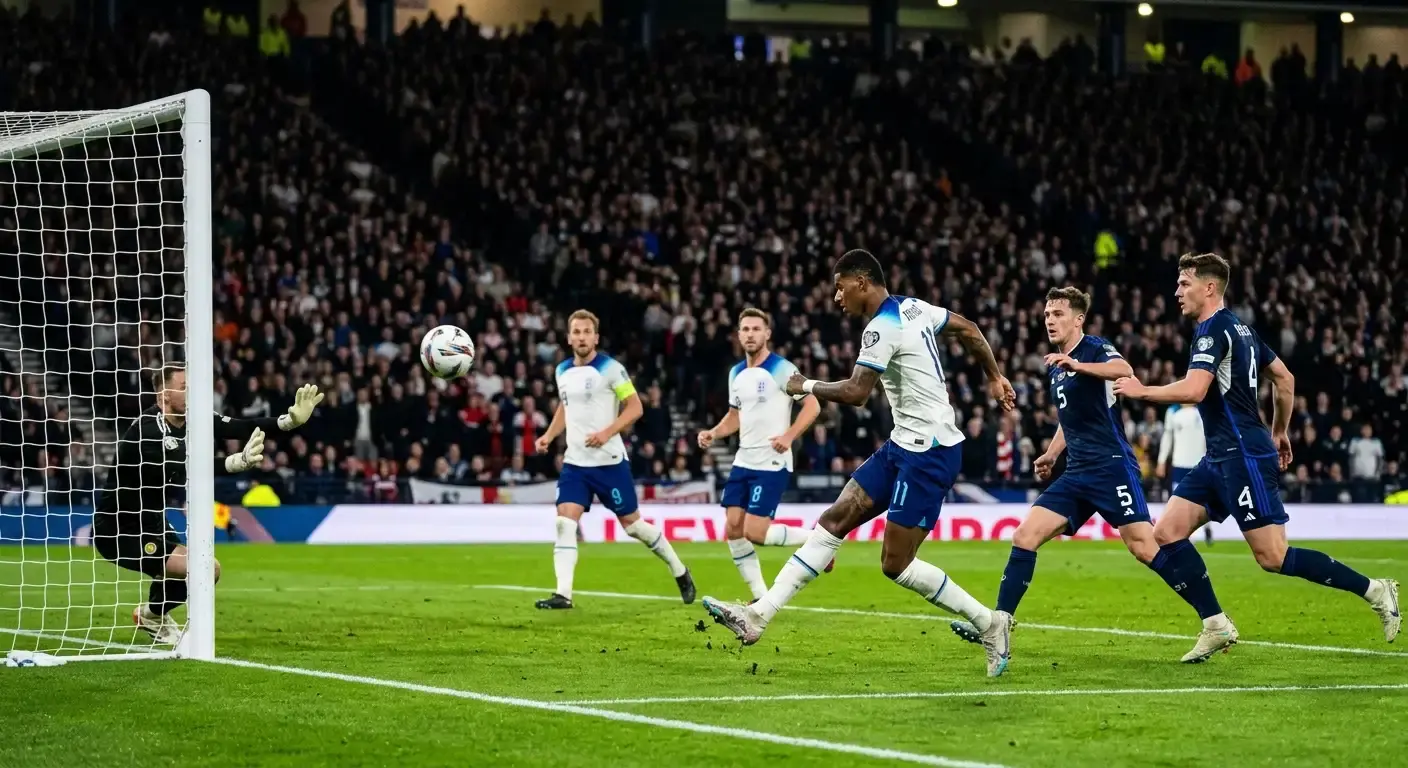
Latency is the gap between an event happening on the pitch and you seeing it. With around eighty per cent of online bets now placed on mobile devices, most in-play betting happens on a phone watching a stream that may be five, ten, even thirty seconds behind the live action depending on the broadcast chain. The bookmaker’s data feed, meanwhile, comes from someone physically at the ground relaying events instantly. So when a chance falls and you think you are reacting fast, the bookmaker already knew about it seconds ago and has already moved or suspended the price. You are perpetually betting into the past.
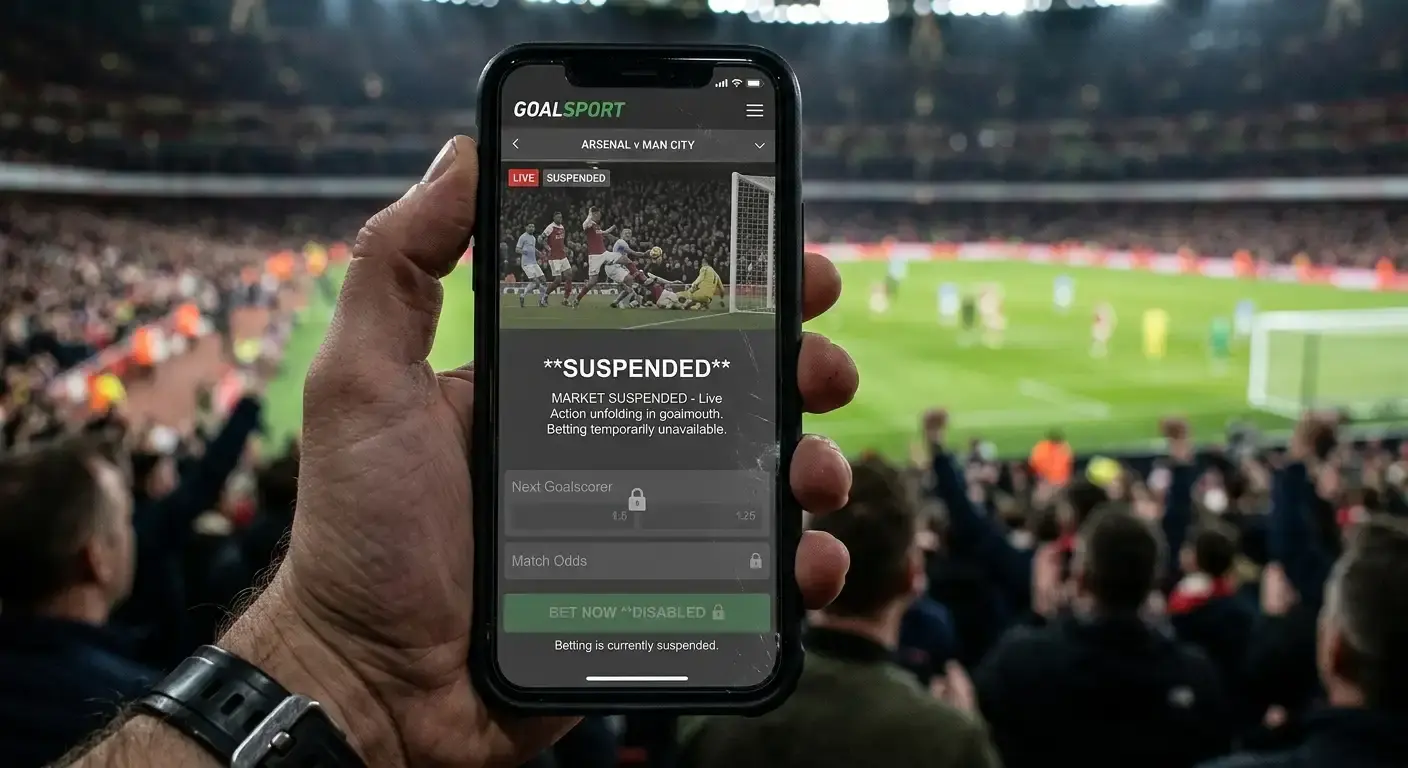
This is where suspensions come in, and once you understand latency they make complete sense. When a significant event looms, a shot on goal, a corner, a penalty appeal, the bookmaker suspends the relevant markets, freezing them so no bets can be placed for a few seconds. The market goes grey, your bet button stops working, and you sit there frustrated as something happens you cannot see yet. The suspension is not the bookmaker being awkward. It is the bookmaker protecting itself from people betting on information the price has not yet absorbed, and it is the clearest possible signal that the market knows something is happening that you do not.
The practical consequence is a discipline rule I follow without exception: never chase a suspended market. If the price suspends just as you were about to bet, the moment has passed, and trying to get a bet on the instant it reopens means you are betting into a price that has already moved against you on information you still cannot see. The latency gap means the recreational in-play bettor is structurally disadvantaged on anything time-sensitive, which is another reason to favour the slower-developing markets, the match result, the goal totals, over the frantic next-goal scramble where the delay hurts you most. You cannot beat the feed. You can only avoid the bets where the feed beats you.
Keeping discipline when the match is live
In-play betting is the format where good bettors most often come undone, and I include myself in that. The reason is not the maths, it is the psychology, because the live experience is engineered to compress the gap between impulse and action until there is no room left for thought. Young men aged eighteen to thirty-four show the highest rate of problem betting at 13.4 per cent, and it is no accident that this is the demographic the live, mobile, fast-twitch product is aimed at most directly.
The structural danger of in-play is volume. A single match can offer hundreds of betting opportunities, a fresh next-goal price every few minutes, a new special after every incident, and each one is a chance to bet that the pre-match format simply did not offer. The bettor who placed one considered bet before kick-off can, in-play, place twenty reactive ones, each made in seconds, each pulling at the adrenaline of the live moment. That volume is where bankrolls quietly disappear, not in one bad bet but in forty small impulsive ones that never passed any filter.
The regulatory environment is sharpening its focus on exactly this, and the people running it know the live product is where the pressure is greatest. Andrew Rhodes, who led the UK Gambling Commission through a period of intense change, observed that “the next five years will be more consequential for gambling regulation than we have seen in many years,” and the speed and intensity of in-play products are squarely in the frame of that scrutiny. The protections being built, deposit limits, reality checks, the friction increasingly required before a bet confirms, exist precisely because the live experience is so good at overriding considered judgement.
My own defences are simple and I apply them ruthlessly. I decide before kick-off whether I am betting this match in-play at all, and if so, roughly how many bets and at what stake, so the live version of me cannot invent new appetite mid-match. I never bet to recover a pre-match bet that has gone wrong, because chasing in-play is chasing with a stopwatch running. And I am honest that most of the next-goal bets I am tempted to make are emotional reactions to the match on screen rather than considered judgements, so the default answer to the impulse is no. The thinking has to happen before the whistle, because once the match is live there is no time to do it well. The one live feature that can genuinely help here, used sparingly, is the ability to close a bet early, which I have broken down fully in my guide to settling a football bet before the final whistle.
Betting live on a phone
Almost all of this happens on a phone now, and the mobile context deserves its own attention because it shapes the behaviour. With roughly eighty per cent of online bets placed on mobile devices, the in-play experience for most people is a small bright screen in the palm of the hand, optimised by some of the best designers in the business to make betting frictionless, which is exactly the problem.
The mobile in-play app is a marvel of engineering aimed at one outcome: getting you to bet more, faster, with less thought. The next-goal price updates in real time, one tap stakes a pre-set amount, the bet builder suggests selections, a notification fires when a market looks tempting. Every piece of friction that might let you pause and reconsider has been deliberately removed. The slick experience that feels like a feature is, from the perspective of your bankroll, a hazard, because the entire interface is tuned to convert hesitation into a placed bet.
The phone also collapses the boundary between watching and betting. On a coupon at the shop, betting was an event you went out to do. On a phone, the bet is one tap away from the match you are already watching on the same device, so every flicker of excitement during a game is instantly actionable. That immediacy is the live product’s whole appeal and its whole danger, and the only counter to it is to put deliberate friction back in. I keep my stake amounts un-preset so I have to type them, which buys me a second of thought. I turn off in-play notifications entirely. And on the matches where I know my discipline is weakest, my own team, the big occasion, the late drama, I simply do not have the app open, because the surest way to win the battle against a phone designed to make you bet is to not pick it up.
Trading the match, not chasing it
In-play betting rewards the patient and punishes the reactive, which is the exact opposite of how it is designed to feel. The format wants you fast, emotional, and constantly engaged. Your edge, if you have one, comes from being slow, detached, and selective, betting the readable markets where the margin is thin and your interpretation can beat the model, and refusing the frantic specials where the latency gap and the fat margin both work against you.
The half of all online betting that now happens in-play is not going to shrink, and the products will only get faster and more immersive. That makes the discipline harder and more valuable in equal measure. Decide before kick-off, favour the slow markets over the fast ones, never chase a suspended price or a losing pre-match bet, and remember that the team battering the door down is rarely the value, because everyone watching can see what you see. The match on screen is moving every second. The bettor who profits is the one who has decided, in advance, exactly how little of that movement to act on.
