

The formula that fixed my staking before it fixed my picks
For years I believed my problem was picking winners. It wasn’t. My problem was that I staked the same flat amount on a coin-flip and on a stone-cold value bet, which meant I was leaving money on the table when I was right and overexposed when I was barely ahead. The Kelly Criterion solved that, and it did more for my returns than any improvement in my actual predictions ever did.
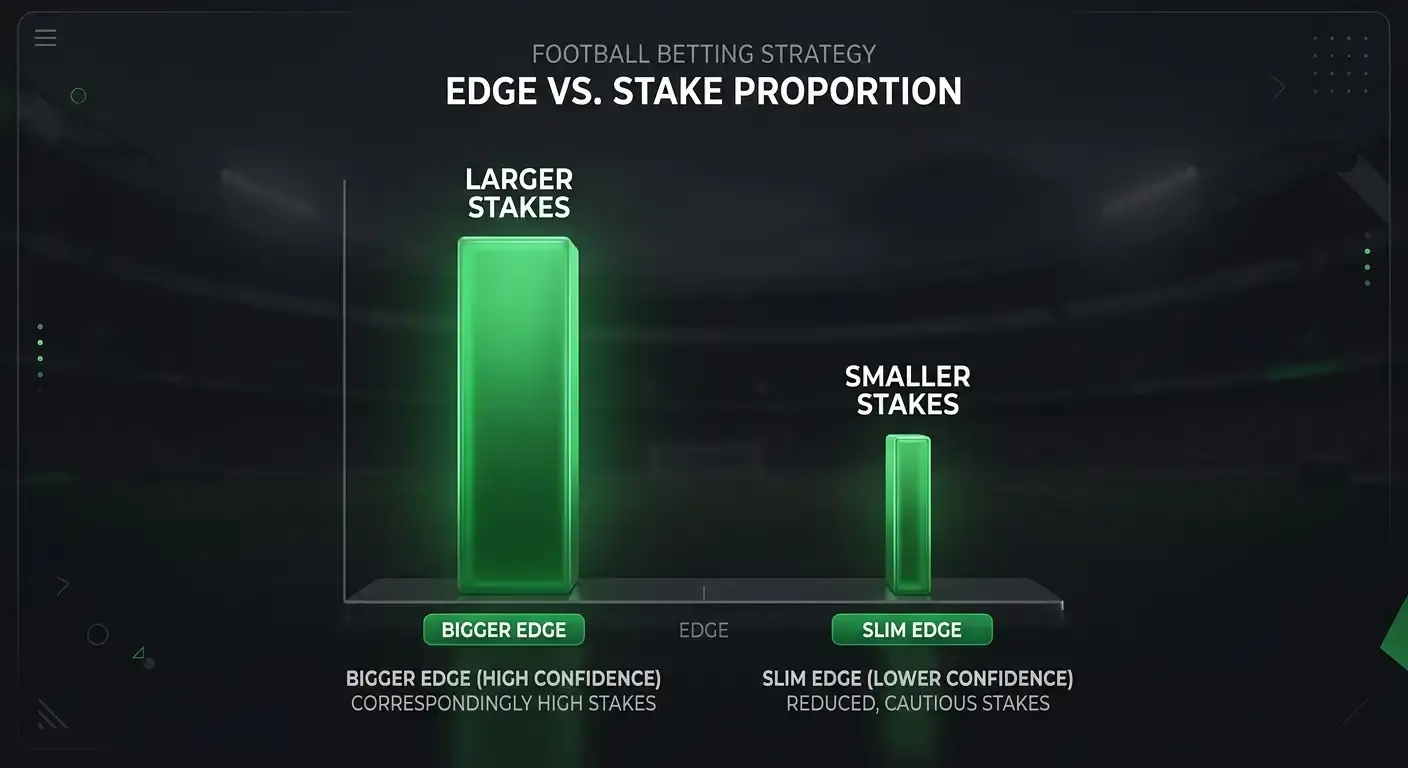
Kelly is a staking formula, nothing more and nothing less. It tells you what fraction of your bankroll to put on a bet given the size of your edge and the odds on offer, with one specific goal: maximising the long-term growth rate of your money. It does not pick your bets, it does not find value, and it cannot rescue a losing method. What it does, brilliantly, is convert a genuine edge into the mathematically optimal stake, betting more when your advantage is large and less when it is slim.
The formula, decoded
The Kelly formula for decimal odds looks intimidating and is genuinely simple once you name its parts. The fraction of your bankroll to stake equals your edge divided by the net odds. In symbols it is often written as f equals bp minus q, all over b, where b is the decimal odds minus one, p is your estimated probability of winning, and q is the probability of losing, which is just one minus p.
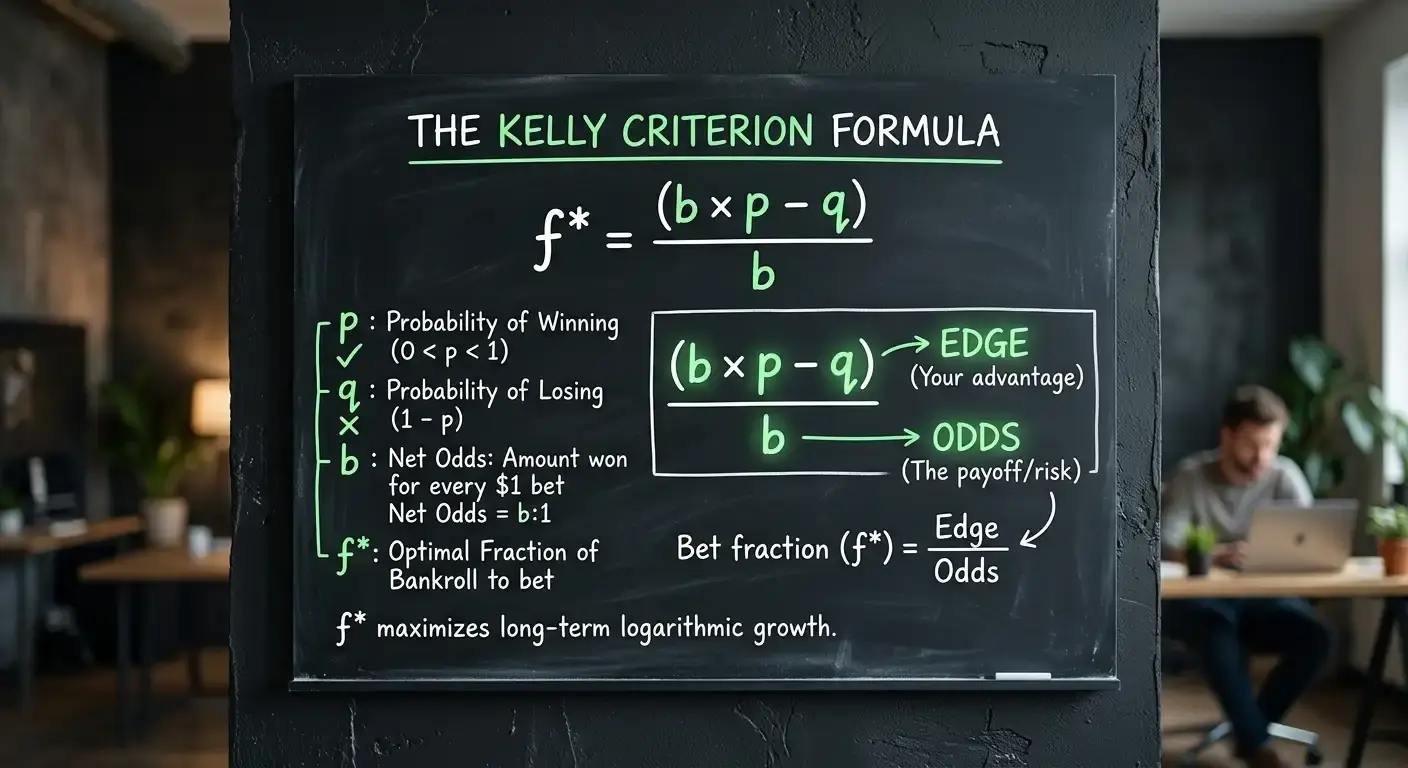
Let me translate that into plain English, because the letters obscure an intuitive idea. The b stands for what you win per unit staked if the bet lands. The bp term is your reward weighted by how often you expect to collect it. The q is the penalty weighted by how often you expect to lose. Subtract the expected loss from the expected gain, divide by the payout, and you get the slice of your bankroll that grows your money fastest over time.
The crucial insight buried in the formula is that Kelly only ever recommends a positive stake when you actually have an edge, meaning your estimated probability beats the price’s implied probability. Feed it a bet with no edge and it tells you to stake nothing. Feed it a negative-edge bet and it produces a negative number, its way of telling you the only winning move is not to play. The formula is honest in a way most punters are not.
A worked football example
Numbers make this concrete, so let me run a clean one. Suppose I have assessed an away side at a true win probability of 50 percent, and a bookmaker is offering 2.20 on that win. My bankroll is one thousand pounds. The first job is to confirm there is an edge at all: the implied probability of 2.20 is one divided by 2.20, roughly 45.5 percent, and my estimate of 50 percent is higher, so a real edge exists.
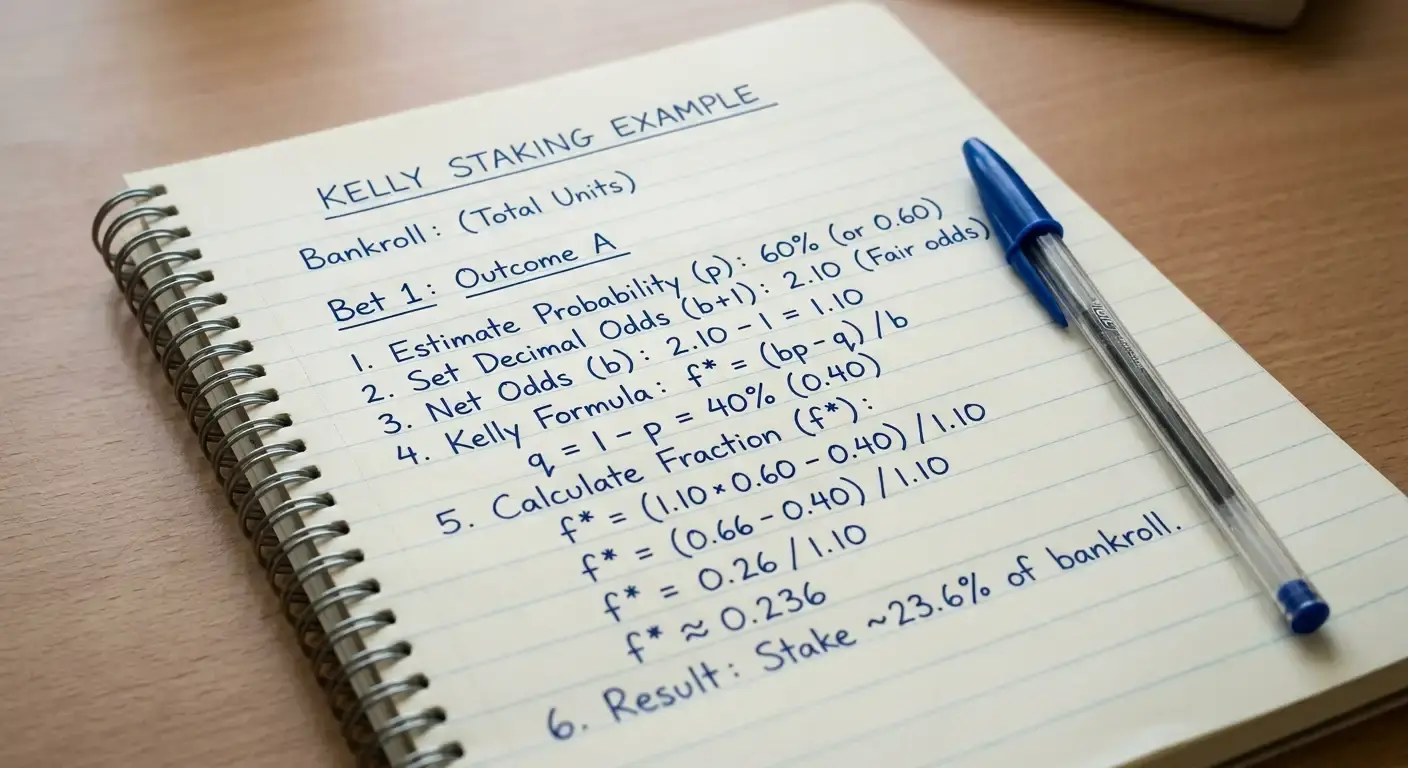
Now I plug into Kelly. The b value is 2.20 minus one, which is 1.20. My p is 0.50 and my q is 0.50. The numerator bp minus q is 1.20 times 0.50, which is 0.60, minus 0.50, giving 0.10. Divide that by b, which is 1.20, and I get 0.0833, or 8.33 percent. Kelly is telling me to stake 8.33 percent of my bankroll, which on a thousand pounds is just over 83 pounds.
Notice how the stake responds to the inputs. If my edge were thinner, say a 47 percent estimate against the same price, the recommended fraction would shrink dramatically. If the odds were longer for the same edge, the fraction would change again. Kelly is constantly translating the relationship between how confident you are and how generously you are being paid into a single, disciplined number, which is exactly what flat staking can never do.
Why almost everyone should use fractional Kelly
Here is the part the textbooks bury and experience teaches fast: full Kelly is brutally volatile. The formula is optimal only if your probability estimates are perfectly accurate, and yours never are. The 8.33 percent stake from my example would be correct only if I truly knew the away side wins exactly half the time, and in reality my estimate carries error. When your inputs are even slightly wrong, full Kelly overbets, and the swings it produces can be stomach-churning even when your method is sound.
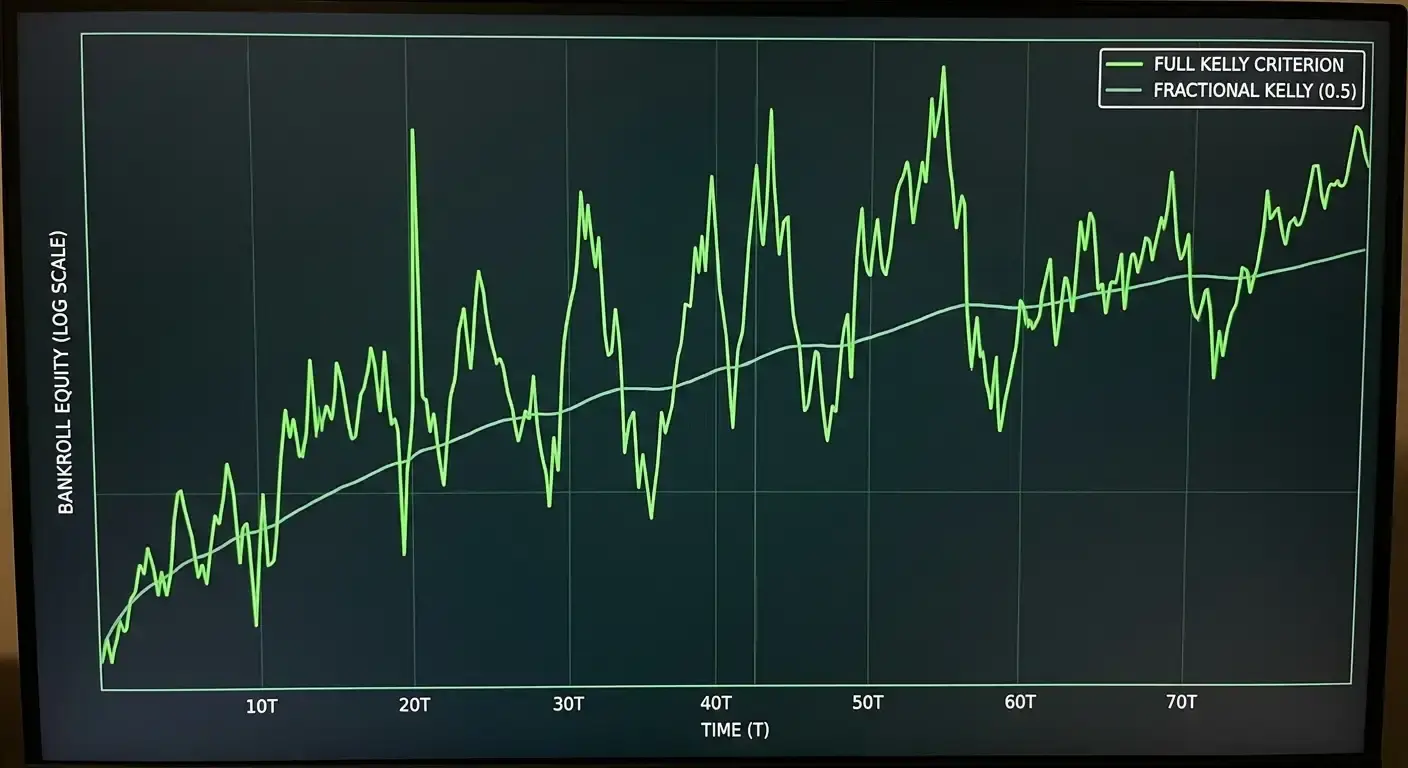
The standard fix is fractional Kelly, where you stake a set fraction of what the formula recommends, most commonly a half or a quarter. Half Kelly on my example would stake about 4.17 percent rather than 8.33, sacrificing a little theoretical growth for a large reduction in volatility. The trade-off is heavily worth it, because half Kelly captures most of the long-term growth while roughly quartering the variance, and it cushions you against the inevitable errors in your probability estimates.
I have never run full Kelly on football in my life and I never will. Quarter to half Kelly is where serious bettors live, because it respects the uncomfortable truth that we are estimating probabilities, not reading them off a card. The fractional approach is not a compromise on Kelly’s logic; it is the honest application of that logic to a world where your edge is real but imprecise.
Where Kelly breaks down
Kelly is a sharp tool that cuts you badly if you misuse it, and the failures are predictable. The biggest is overestimating your edge. The formula is exquisitely sensitive to the probability you feed it, so if you talk yourself into a 55 percent chance on a bet that is really 50 percent, Kelly will recommend a wildly oversized stake and the maths that was supposed to protect you will instead accelerate your ruin. Garbage in, leverage out.

The second problem is the betting environment itself. Kelly assumes you can keep betting your edge indefinitely, but in practice the bookmaker’s margin is rising, with the average hold rate climbing from 6.7 percent in 2018 to 10.15 percent in 2025, which means edges are thinner and harder to sustain than the clean formula assumes. Successful bettors also get their stakes restricted or their accounts limited, which quietly breaks Kelly’s assumption that you can scale your stake with your bankroll without interference.
Kelly also says nothing about correlated bets. Stake several positions that all depend on the same outcome and treating each with its own Kelly fraction massively overexposes you, because the formula assumes independence it does not check for. For all these reasons I treat Kelly as a disciplined input to my staking rather than a law to obey blindly, and it works best sitting inside a broader staking framework. If you want the full structure that Kelly plugs into, my guide to units, staking and drawdown shows how the pieces fit together. Use Kelly to size your conviction honestly, fraction it to survive your own errors, and never let a tidy equation convince you that you know more than you do.
