


Borrowed from the racecourse, perfected on the pitch
Each way betting wandered over from horse racing, and for years football punters treated it as something for the Grand National rather than the Premier League. That has changed completely. Football betting is now the single largest segment of regulated remote gambling in the UK, worth 1.3 billion pounds in gross gambling yield, and as the markets have multiplied, each way has become one of the most useful and most misunderstood tools in the box.
The idea is to hedge your optimism. Instead of needing your selection to win outright, an each way bet pays out a reduced amount if it merely finishes in one of the leading places. You are splitting your conviction down the middle: half says “this will win”, half says “if it doesn’t quite win, it’ll go close”. On the right market that structure is genuinely valuable. On the wrong one it is a quiet leak. Knowing the difference is the whole skill.
How the stake splits in two
An each way bet is actually two separate bets bundled under one name, and this trips up almost everyone the first time. When you stake ten pounds each way, you are putting ten pounds on the win and ten pounds on the place, for a total outlay of twenty pounds. The “each way” refers to the fact that your stake goes on each of the two ways the bet can pay.
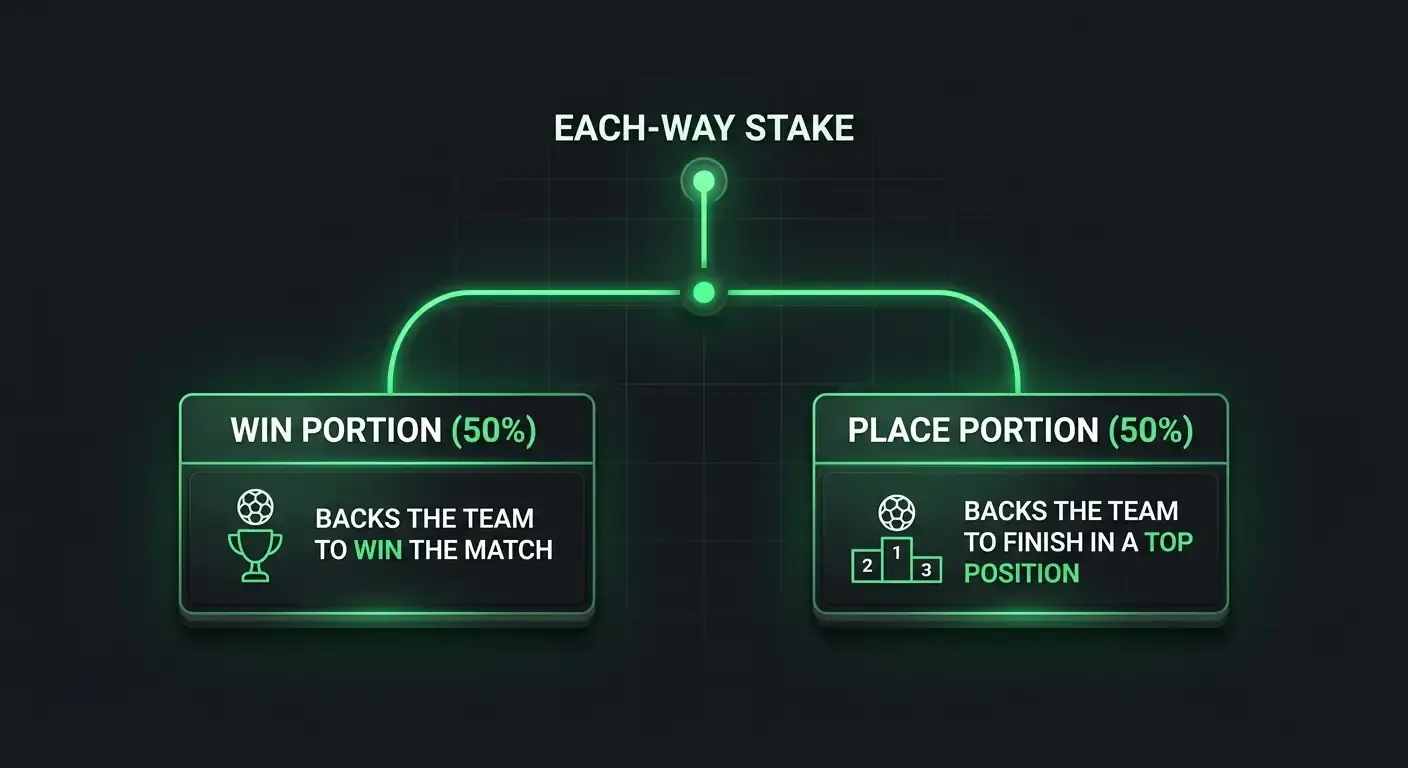
The win half settles exactly as you would expect: if your selection wins, it pays out at the full odds. The place half settles at a fraction of those odds, paying out if your selection finishes within the specified number of places. So if your pick wins, both halves pay and you collect handsomely. If it places without winning, only the place half pays, and because that pays at a fraction of the odds, you might recover your total outlay plus a modest profit, break even, or even take a small loss depending on the price and the place terms.
That final possibility surprises people. A short-priced selection that places but doesn’t win can actually return less than your combined stake, because the win half is lost and the reduced place return doesn’t cover both bets. Each way is not a guaranteed safety net; it is a structured bet with its own break-even maths, and you have to run those numbers before you stake.
Reading the place terms that decide everything
The place terms are the engine of an each way bet, and they vary wildly between markets, so I never place one without checking them. Two numbers matter: how many places pay, and what fraction of the odds the place half settles at. A typical outright football market might pay the first three or four places at one-fifth of the odds, but those figures shift with the size of the field and the bookmaker’s terms.
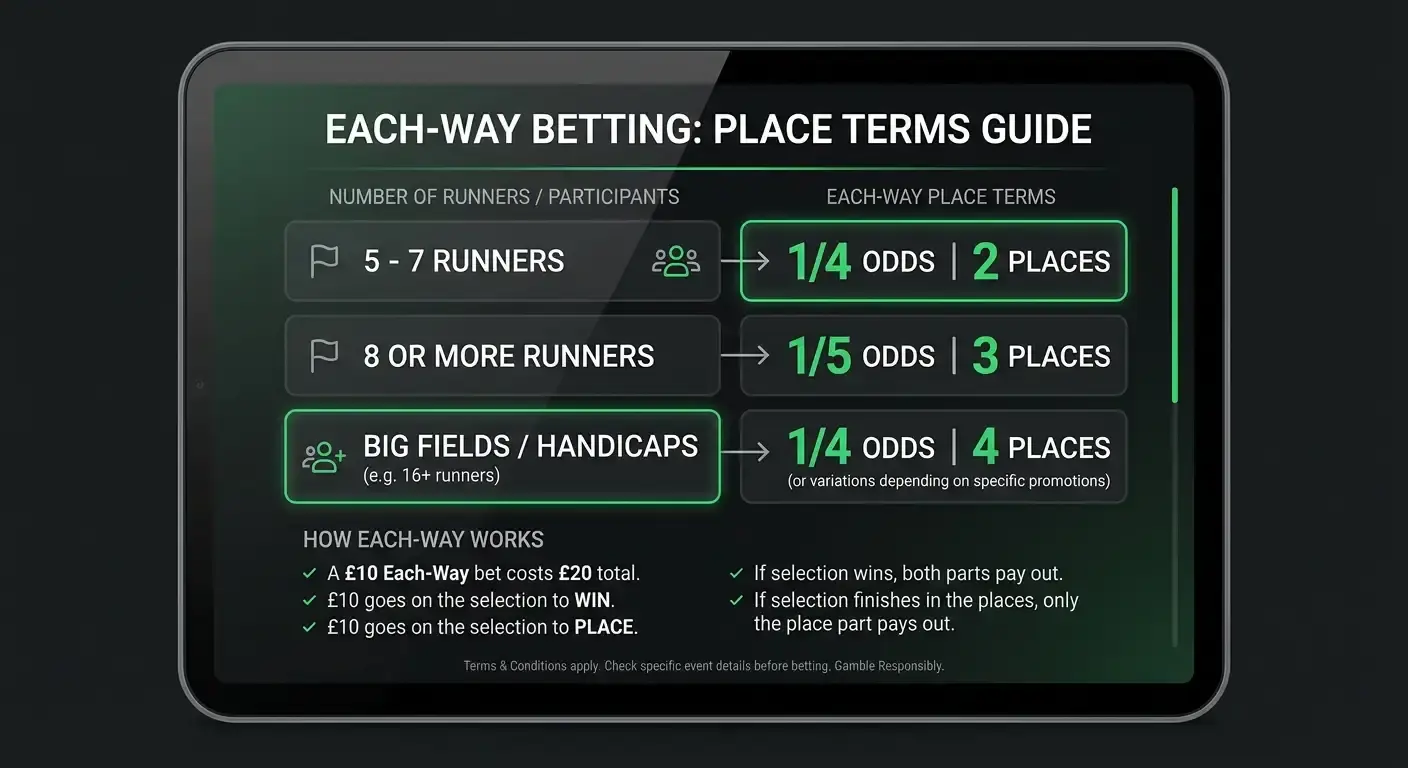
The number of places is driven by how many participants there are. A title race with twenty teams pays more places than a two-horse promotion battle, and a top goalscorer market across an entire league might pay four or five places because so many strikers are in contention. More places mean more ways to collect on the place half, which sounds better but is reflected in the odds.
The fraction is where the value is won or lost. One-fifth odds on the place means a 20.00 selection pays your place stake at 4.00 if it places; one-quarter odds would pay at 5.00. That difference is enormous over time, and it is exactly the sort of detail recreational punters skip past. The roughly 47% of UK adults who gamble in some form mostly never read the place terms at all, which is precisely why the bettors who do can find an edge in this market.
The markets where each way shines
Each way belongs on outright and futures markets, full stop. Backing a team to win the Premier League each way, where the place terms might pay a top-four or top-six finish, lets you profit from a strong season that falls short of the title. Backing a player for the golden boot each way pays out if he finishes among the leading scorers even if a rival edges the award. These are markets with large fields, long odds and meaningful place terms, which is the combination each way was built for.

The richest hunting ground is the top goalscorer market, where a clutch of strikers are realistically in contention and a generous bookmaker pays several places. A 15.00 shot to finish top scorer who is genuinely capable of finishing in the top four or five represents real each way value, because the place half has a solid chance of landing while the win half offers the upside. The same logic applies to tournament outright markets, which is where outright and ante-post betting and each way naturally overlap; my guide to ante-post and futures markets covers the timing side that makes these bets pay.

Where each way fails is on short-priced selections and small fields. A two-way promotion market with no meaningful place terms gives you nothing to hedge, and a heavy favourite at low odds produces a place return so small it barely registers. Each way needs length and breadth in the market to function; strip those out and you are just paying twice for a bet that only really wants to win.
Running the value check before you commit
Before any each way bet, I do a thirty-second calculation that most punters never bother with, and it has saved me from countless bad slips. I work out what the place half actually returns if the selection places without winning, then ask whether that return, combined with the times the win half lands, justifies doubling my stake compared to simply backing the win alone.

The key insight is that each way is only worth it when the place portion has genuine value at the offered terms. If a bookmaker pays generous place terms on a wide-open market, the place half can be a profitable bet in its own right, and the win half becomes a free shot at the bigger payout. If the place terms are stingy or the field is small, you are better off putting your whole stake on the win and accepting the higher variance.
I also weigh whether I would rather concentrate my conviction. On a selection I rate strongly to win, splitting the stake dilutes the win bet for the sake of a place insurance I may not need. Each way is a tool for spreading risk across a wide market where placing is a realistic and well-paid outcome, not a reflex to bolt onto every outright I fancy. Used with that discipline, it is one of the few football markets where the structure itself can hand you an edge.
