


The bet the bookmaker wants you to make
Every Saturday morning, somewhere in Britain, a group chat fills up with screenshots of the same thing: a five-fold acca, four legs already won, one to go, and a potential return that would cover a holiday. I have been in those chats. I have placed those bets. And I have learned, the hard way and then the analytical way, exactly why the bookmaker loves them more than any other bet on the coupon.
Here is the figure that should be printed on every accumulator slip. Accas and parlays produce sixty to seventy-five per cent of all bookmaker revenue while making up only twenty-five to thirty-five per cent of the money staked. That is not a quirk. It is the single most important fact in this article. The bet that feels like the best value on the menu, the small stake for the life-changing return, is the bet that funds the industry, and once you understand the mechanism behind that you will never look at a five-fold the same way again.
The popularity is no accident either. The proportion of bettors placing parlay-style bets nearly doubled from seventeen per cent in 2018 to thirty per cent by 2024, a surge the operators have actively encouraged because the maths runs so heavily in their favour. I am not here to tell you never to bet an acca. I bet them myself, with my eyes open. I am here to show you the machinery underneath so that when you do bet one, you are doing it as an informed choice rather than as the bookmaker’s favourite customer.
By the end of this you will understand precisely how combined odds multiply, why that multiplication compounds the bookmaker’s edge against you, how the various acca features and insurance offers actually price up, and what a sensible relationship with accumulators looks like for someone who wants to keep betting for years rather than fund someone else’s quarterly results.
How accumulators combine odds
The mechanism is multiplication, and that one word explains both the appeal and the trap. An accumulator combines several selections into a single bet where every leg must win for the bet to pay out, and the odds are not added together, they are multiplied. That multiplication is why a handful of modest prices turns into a spectacular potential return, and it is also why accas are so much harder to win than they look.
Work a clean example with decimal odds, because decimals make this transparent in a way fractions never could. Say you pick four selections, each priced at 2.00, which is even money, a coin flip. A single 10 pound bet on any one of them returns 20 pound. Combine all four into an acca and you multiply the odds: 2.00 times 2.00 times 2.00 times 2.00 equals 16.00. Your 10 pound stake now returns 160 pound. The leap from 20 pound to 160 pound is intoxicating, and it is doing exactly what it is designed to do.
But look at what you have actually taken on. Each leg is a coin flip, a fifty per cent chance. For the acca to win, all four coin flips must land. The probability of that is 0.5 times 0.5 times 0.5 times 0.5, which is 0.0625, or 6.25 per cent. You have a return of sixteen times your stake on a bet with a one-in-sixteen chance. Now here is the part that matters: a fair price for a 6.25 per cent chance would be odds of 16.00, which is exactly what you are getting. In this idealised example with no margin, the acca is fairly priced. The problem, as we are about to see, is that real odds are never margin-free, and the multiplication does something nasty to the margin.
The other thing multiplication does is make accas brutally unforgiving. In a single bet, one bad result costs you one bet. In a four-fold, one bad result, a 94th-minute equaliser in any one of the four matches, costs you the entire bet. The more legs you add, the more spectacular the potential return and the more certain the disappointment, because you are now hostage to every refereeing decision, every injury, every freak result across multiple matches simultaneously. The acca does not just multiply the odds. It multiplies the ways you can lose.

Why bookmakers love accumulators
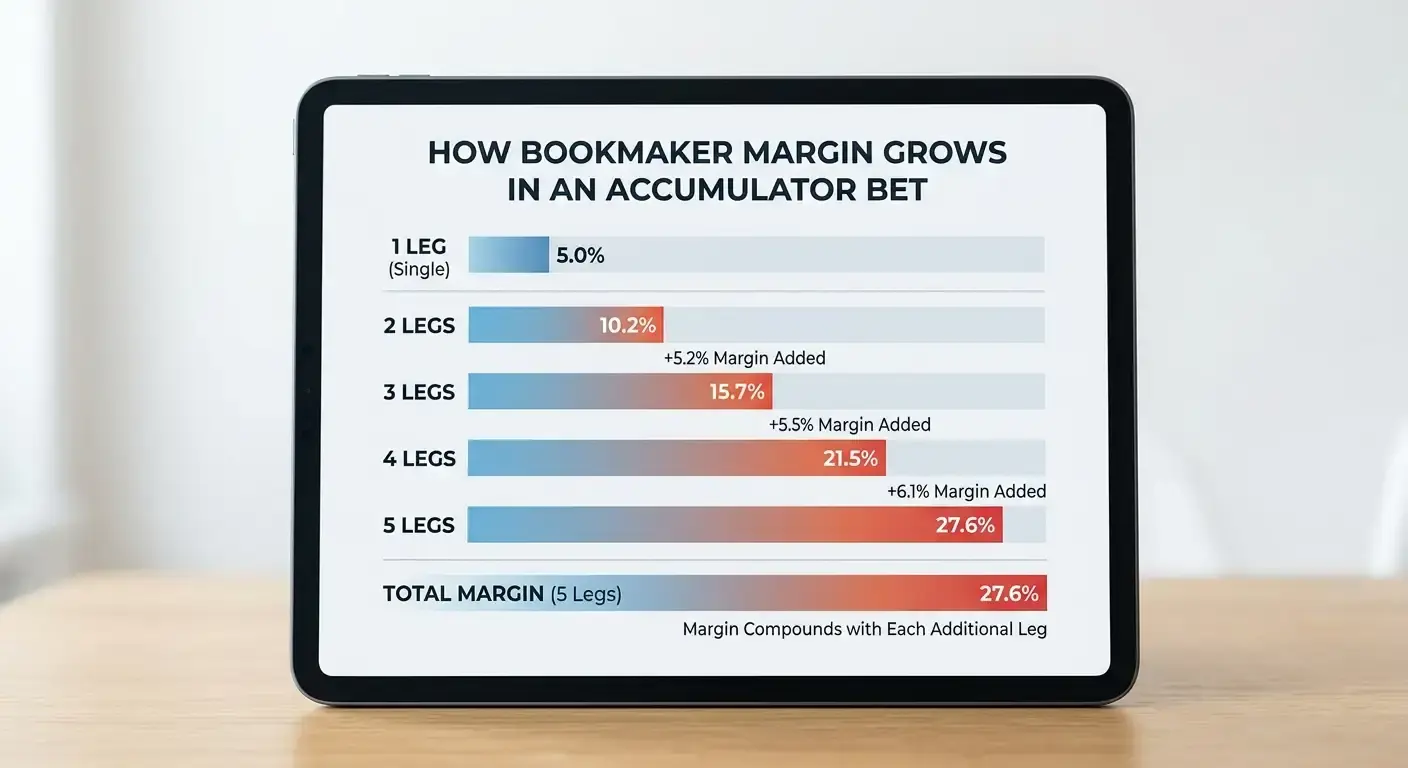
I promised to show you the machinery, so here it is, and it is the most important section in this piece. The reason accas generate sixty to seventy-five per cent of bookmaker revenue off a minority of the staked money is that the bookmaker’s margin compounds with every leg you add. The overround you pay on a single bet, multiplied across four or five legs, becomes a far larger bite than most bettors ever realise.
Let me rebuild the four-fold with realistic prices to expose it. In the margin-free version, each leg was 2.00 with a true fifty per cent chance. But real bookmaker odds for a fifty per cent shot are not 2.00, they are more like 1.91, because the bookmaker has shaved a margin into the price. The implied probability of 1.91 is about 52.4 per cent, not fifty, and that extra 2.4 per cent is the house edge on a single bet. Annoying, but survivable.
Now multiply four of those margin-loaded prices together. Four legs at 1.91 give a combined price of 1.91 times 1.91 times 1.91 times 1.91, which is about 13.3, not the 16.0 you would get from fair odds. You are being paid 13.3 for an outcome that is genuinely worth 16.0. The margin has not added up across the legs, it has multiplied, and the gap between what you are paid and what the bet is worth has ballooned from a couple of per cent on a single to something far more punishing on the acca. The more legs, the worse it gets, which is why a ten-fold can carry an effective margin that would make a loan shark blush.
This compounding is the entire reason the industry promotes accas so hard, and the data on hold rates shows the squeeze tightening over time, with average margins rising from 6.7 per cent in 2018 to 10.15 per cent by 2025. Stack a rising single-bet margin across multiple legs and the effective acca margin climbs steeply. The bookmaker is not hoping you lose your acca. The bookmaker is mathematically advantaged on it from the moment you place it, far more so than on any single bet, and that advantage is built into the prices rather than depending on the result.
None of this means accas are a scam. They are a clearly priced product doing exactly what the price says. But the price is worse than it looks, hidden behind the dazzle of the potential return, and the bettor who understands the compounding margin treats the acca as a high-cost entertainment product rather than a route to profit. That single reframing is worth more than any tipster’s selections.
Acca types and folds
Walk into the terminology cold and the bookmaker’s acca menu reads like a foreign language: doubles, trebles, four-folds, Lucky 15s, Yankees, Trixies. It sounds complicated and it is mostly not, so let me translate the parts you will actually meet rather than the exotic full-cover bets that exist mainly to extract more stake.
The straight accumulator is the simplest and the one most people mean. A double is two selections, a treble is three, a four-fold is four, and so on, all of which must win for the bet to pay. The “fold” just counts the legs. A 10 pound four-fold means 10 pound staked across four selections that all need to come in. This is the acca in its pure form, the multiplication machine from the previous sections, and it is what I would steer any beginner towards if they are betting accas at all, because at least the cost is transparent.
Then there are the full-cover bets, which combine multiple smaller accas from the same set of selections. A Trixie, from three selections, contains three doubles and a treble, four bets in total. A Yankee, from four selections, contains six doubles, four trebles and a four-fold, eleven bets. A Lucky 15, also from four selections, adds the four singles to make fifteen bets. The appeal is that you do not need every selection to win to get a return, because the smaller combinations within the bet can still pay. The catch is that your stake is multiplied by the number of bets: a 1 pound Lucky 15 is a 15 pound bet, not a 1 pound bet, and the margin applies to every one of those fifteen combinations.
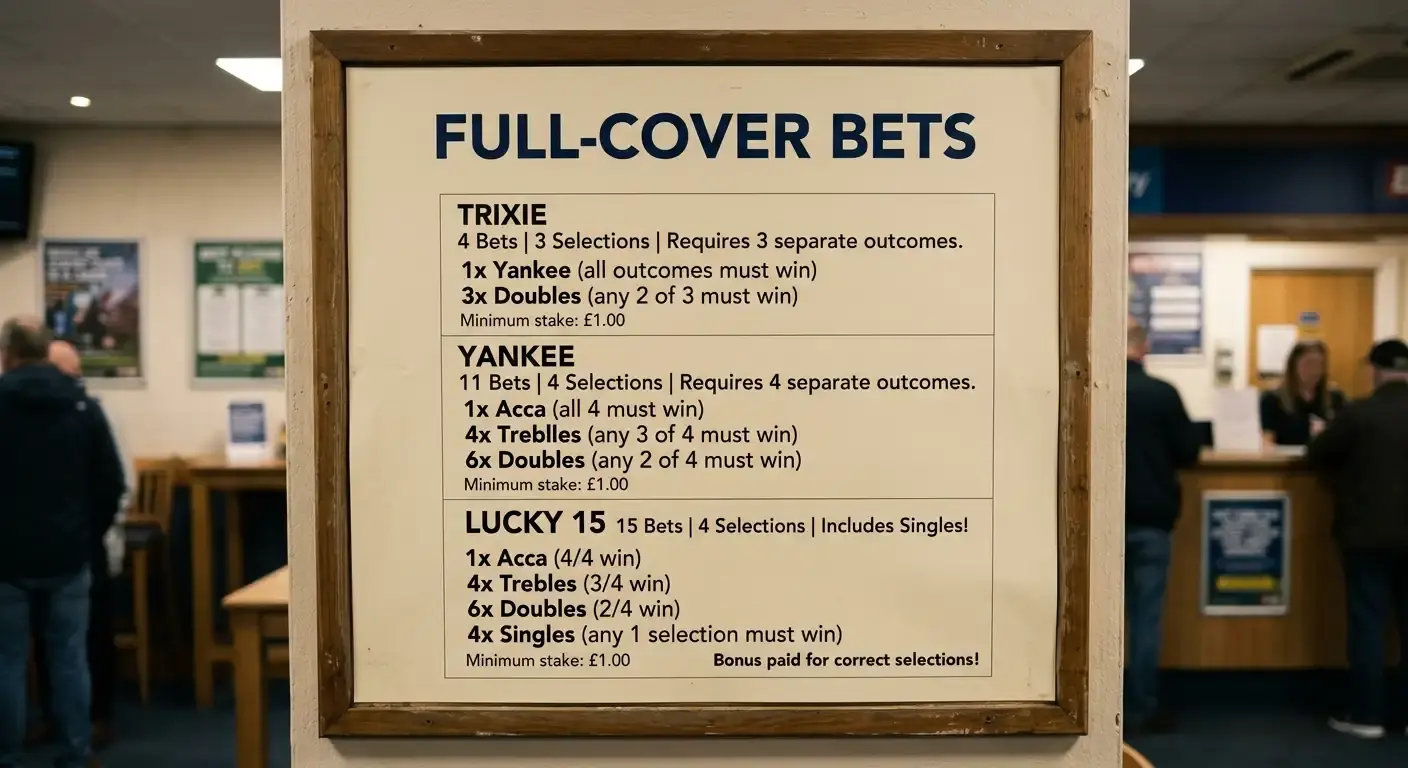
Full-cover bets are sold as a safety net, and in a narrow sense they are, because partial returns are possible. But you are paying for that safety net with a much larger total stake spread across many margin-loaded combinations, and the maths rarely favours you over simply staking less on a straight acca or a few singles. My honest view, after years of watching people chase Lucky 15 near-misses, is that the full-cover bets mostly serve to get more money on the coupon. If you want partial returns, you are usually better off betting selections individually and keeping control of your stake on each.
Acca insurance and the freeze
“Acca insurance” is the offer that pulled me into more accas than I care to admit in my early years, and unpicking how it actually prices was a genuine turning point. The pitch is irresistible: place a five-fold or bigger, and if exactly one leg lets you down, the bookmaker refunds your stake as a free bet. It feels like the house has handed you a parachute. It has not. It has handed you a marketing cost it has already priced into your account.
Start with what the offer really is. Acca insurance refunds your stake, usually up to a cap and usually as a free bet rather than cash, when one and only one leg loses from an acca of a minimum size. The free bet matters, because a free bet is worth less than its face value: when you stake a free bet you do not get the stake portion back in your return, only the profit, so a 10 pound free bet is worth roughly seven to eight pound in real terms depending on the odds you use it at. The “refund” is already worth less than it sounds before you have done anything.
Now think about why the bookmaker offers it. Insurance is dangled on accas of five legs or more, precisely the bets where the compounding margin is fattest. The bookmaker is happy to refund the occasional single-leg miss because the overall edge on a five-fold-plus is so large that the cost of the refunds is comfortably covered by the margin on all the accas that lose two or more legs, plus all the ones that win and pay out at prices already shaded in the house’s favour. The insurance does not reduce the bookmaker’s edge. It is funded by it, and it exists to encourage you onto the longer accas where that edge is greatest.

The acca freeze, sometimes called acca cash out or a similar brand name, is a related feature: it lets you “freeze” one leg of your acca, removing it from the bet so the remaining legs run on, typically once per acca and usually only on bigger accas. Like insurance, it is presented as control handed to you, and like insurance, the price of that control is baked into the product. Used very occasionally to protect a near-complete acca where the final leg has turned sour, these features are not the worst thing you can do. Used as a reason to bet longer accas than you otherwise would, they are doing exactly what they were designed to do, which is increase your volume on the bookmaker’s most profitable product.
Same-game accas versus multi-match
The biggest change in accumulator betting during my time in this game has been the rise of the same-game acca, and the numbers show how completely it has taken over. Forty-one per cent of bettors in a recent US census named the same-game parlay or bet builder as their preferred bet type, overtaking almost everything else, and the same surge is reshaping the UK market. Understanding why same-game accas are different, and usually worse value, is essential.
A traditional multi-match acca combines selections from different matches: Liverpool to win, plus over 2.5 goals in the Madrid derby, plus both teams to score at Dortmund. Because these are separate matches, the outcomes are broadly independent of one another, which means the bookmaker can price them by straightforward multiplication, and the margin, while compounding as we have seen, behaves predictably. A same-game acca, by contrast, combines selections from within a single match: Manchester City to win, plus over 2.5 goals, plus a particular player to score, all in the same game.
The problem with same-game accas is correlation, and it cuts both ways in the bookmaker’s favour. Selections within one match are not independent. If City win comfortably, it is more likely there were over 2.5 goals and more likely a forward scored, so these outcomes move together. A naive multiplication of the odds would misprice a correlated bet badly, so bookmakers use sophisticated models to adjust the price, and they adjust it conservatively, building in extra margin to protect against the correlation working in the bettor’s favour. The result is that same-game accas typically carry even heavier effective margins than multi-match accas of the same number of legs.
This is where the same-game acca shades into the bet builder, a closely related product with its own quirks around correlated selections, and I have gone into the pricing of those in detail in my guide to the football bet builder and combining markets within one match. The short version for accumulator purposes is this: if you are going to bet an acca, a multi-match acca of independent selections is the more honestly priced product. The same-game acca is more fun, more heavily marketed, and quietly more expensive, which is precisely the combination the industry has learned converts best.

A sensible relationship with accas
So where does all this leave the Saturday group chat and its life-changing five-fold? Not in the bin, but firmly relabelled. After everything we have pulled apart, the sensible position on accumulators is the one I have arrived at after years of betting them: treat them as entertainment with a known, high cost, never as a strategy, and size them accordingly. The American Gaming Association’s Bill Miller framed the right mindset neatly when he said the industry “encourages all football fans to have a game plan before placing a bet,” and an acca without a game plan is just hope with a multiplier on it.
The first rule is stake. Because the compounding margin makes accas a high-cost product, the stake should be money you are entirely comfortable losing, sized as entertainment rather than investment. The small-stake-large-return shape of the acca is actually well suited to this: a couple of pounds on a weekend acca, treated like the price of the entertainment it provides, is a perfectly reasonable thing to do. The trouble starts when people scale that up, chasing the return rather than enjoying the ride, because the margin that is trivial on a 2 pound acca is punishing on a 50 pound one.
The second rule is leg count. Every leg you add multiplies the margin against you and multiplies the ways you lose, so fewer legs is almost always better value. A double or a treble of selections you genuinely rate is a defensible bet. A ten-fold of selections you barely know, strung together for the size of the potential return, is the bookmaker’s dream. If you must bet accas, keep them short, keep the selections to things you would bet as singles anyway, and resist the app’s relentless suggestions to add just one more leg. The rising hold rates of recent years, climbing from 6.7 per cent in 2018 towards double figures, mean the cost of those extra legs is higher than it has ever been.
The third rule is honesty about what the features are for. Acca insurance, the freeze, the boosted long-shot accas the app pushes at you, are all engineered to increase your volume on the most profitable product in the shop. Recognising them as marketing rather than gifts is the difference between using an occasional feature sensibly and being steered into a betting pattern that works against you. The acca is a fine bit of weekend fun. It is a terrible plan. Hold both of those thoughts at once and you will enjoy your Saturday coupon without funding quite so much of the bookmaker’s year.