


The bet that asks for your patience as collateral
The best outright bet I ever placed was struck in July and did not settle until the following May. For ten months my stake sat locked away while a season played out, and when it finally landed at a price three times shorter by the time the market caught up, the patience felt entirely justified. Outright betting is a fundamentally different discipline from picking a match winner, because you are committing money to an outcome that resolves over weeks or months, and that time horizon changes everything about how you should approach it.
Outright markets, sometimes called ante-post or futures, ask you to back the winner of a competition, a promotion race, a relegation battle or any season-long outcome, well before the result is known. The appeal is the price: you can lock in long odds before a developing story shortens them, capturing value the match-by-match markets never offer. The cost is your patience and your liquidity, because that stake is tied up for the duration, and a great deal can go wrong before the outcome resolves.

Ante-post and futures: the same idea, different worlds
The terms ante-post and futures describe the same basic concept, betting on an outcome ahead of time, but they carry different connotations worth understanding. Ante-post is the older, racing-derived term that traditionally implies betting well in advance, often before the field is even finalised, and it historically came with the harsh rule that a non-runner meant a lost stake. Futures is the broader, more modern term for any long-range market on a season or tournament outcome.
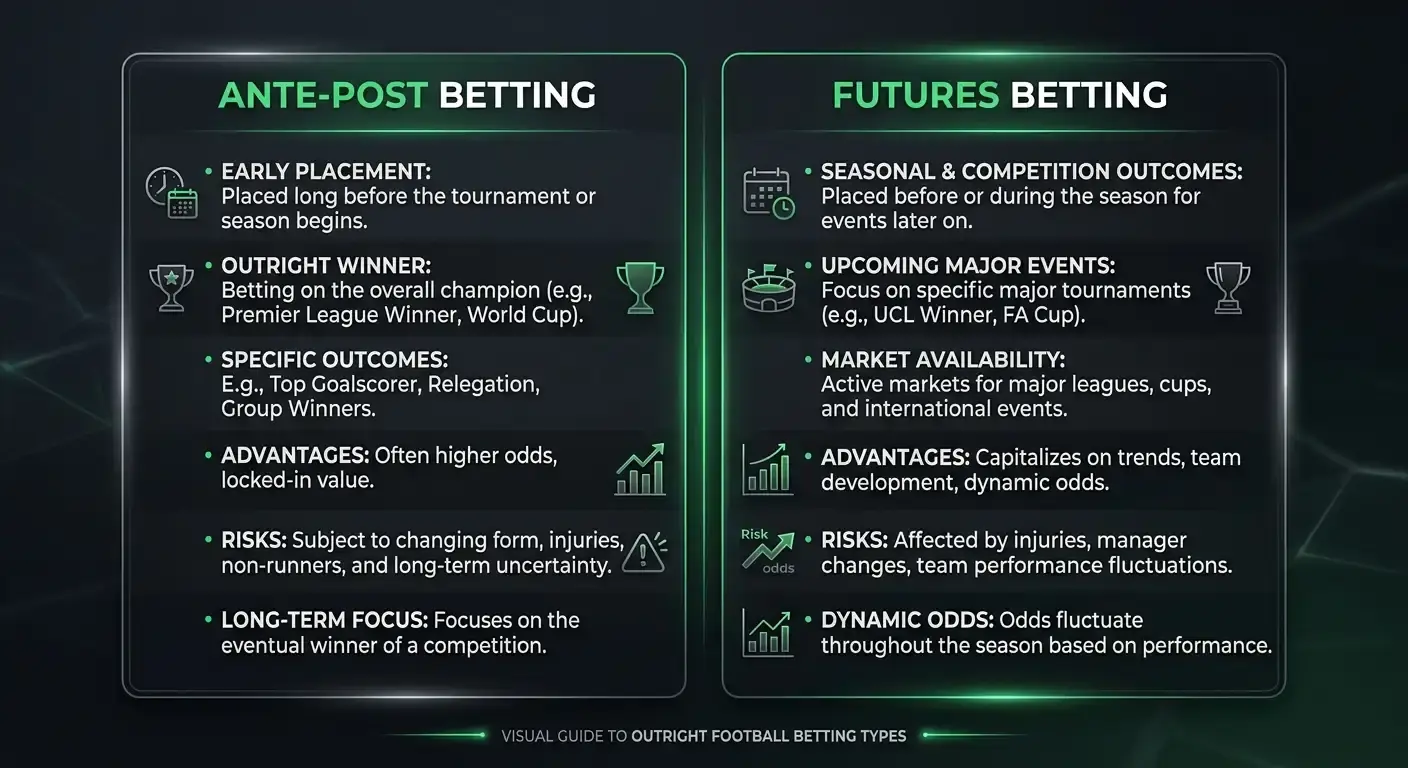
In football, the distinction matters most around what happens to your money if things change before the event. A futures bet on the Premier League title, placed in August, is a long-range market where the participants are known and fixed, so the main risk is simply that your selection underperforms. A true ante-post bet placed even earlier, before a tournament’s qualifiers are decided, carries the additional risk that your selection might not even take part, and the settlement rules around that vary by bookmaker and market.
The practical takeaway is to read the specific terms of any long-range market before you commit, because the label tells you the spirit but the rules tell you the consequences. The global sports betting market was valued at over 112 billion dollars in 2025 and is forecast to more than double by 2035, and as that market grows, the variety of long-range and futures products multiplies, each with its own settlement small print that the careful bettor checks rather than assumes.
Timing the market for the longest price
The entire value proposition of outright betting rests on timing, and getting it right is the difference between a shrewd bet and a poor one. Prices are at their longest at the point of maximum uncertainty, which is typically before a season or tournament begins, before any results have shaped the narrative and before the market has firmed up around emerging favourites. Backing a contender at that moment, when the price reflects pure uncertainty rather than evidence, is where outright value is born.
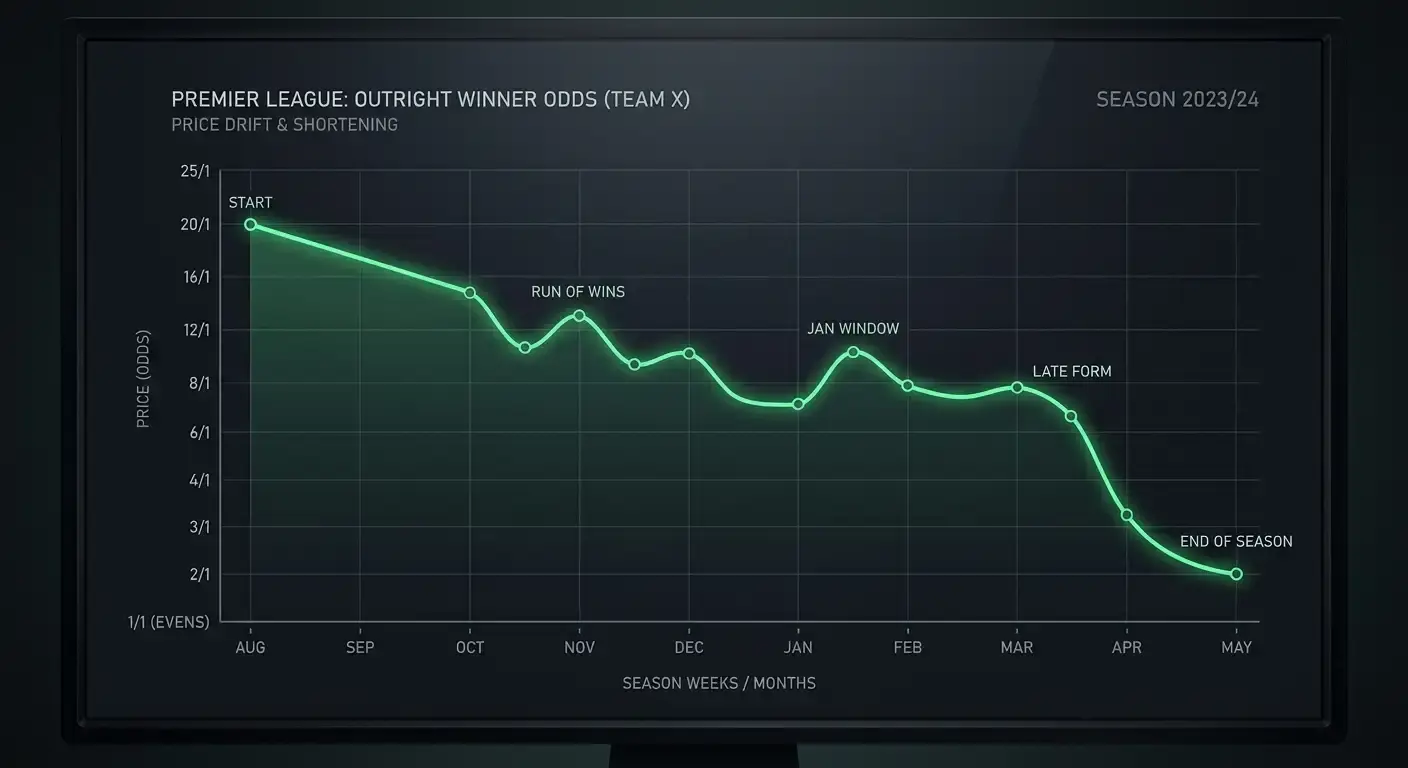
The skill is in identifying a selection whose true chance exceeds what the early, uncertain price implies. A newly strengthened side that the market has not yet re-rated, a club with a settled squad and a favourable run, a team whose summer recruitment the public has underestimated, these are the early positions that pay when the season unfolds as you anticipated and the price collapses around your locked-in odds. Surveys ahead of the 2026 calendar found 68 percent of UK bettors planned to bet more across the year, much of it driven by tournament football, and that surge of interest tends to shorten the headline outright prices quickly once the action begins, which is precisely why getting in early matters.
There is a counterpoint, though, which is that betting too early carries its own risk. The longest prices are long because the most can still go wrong, and an injury, a managerial change or a poor start can sink a months-long position before it ever has a chance. I balance the value of an early price against the risk of the unknown, and I generally favour striking when I have enough information to be confident but before the market has fully priced that information in. That window, between knowing enough and the price moving, is where the best outright bets live.
Voids, Rule 4 and the small print that bites
Two settlement rules govern outright betting, and ignoring either of them is how a winning-looking bet turns into a disappointment. The first concerns voids: what happens to your stake if the event itself is cancelled or fundamentally altered. In a futures market on a season that is abandoned, or an ante-post bet on a competition that does not proceed as expected, the bookmaker’s rules determine whether you are refunded or lose your stake, and those rules differ enough that you must know them before you bet.
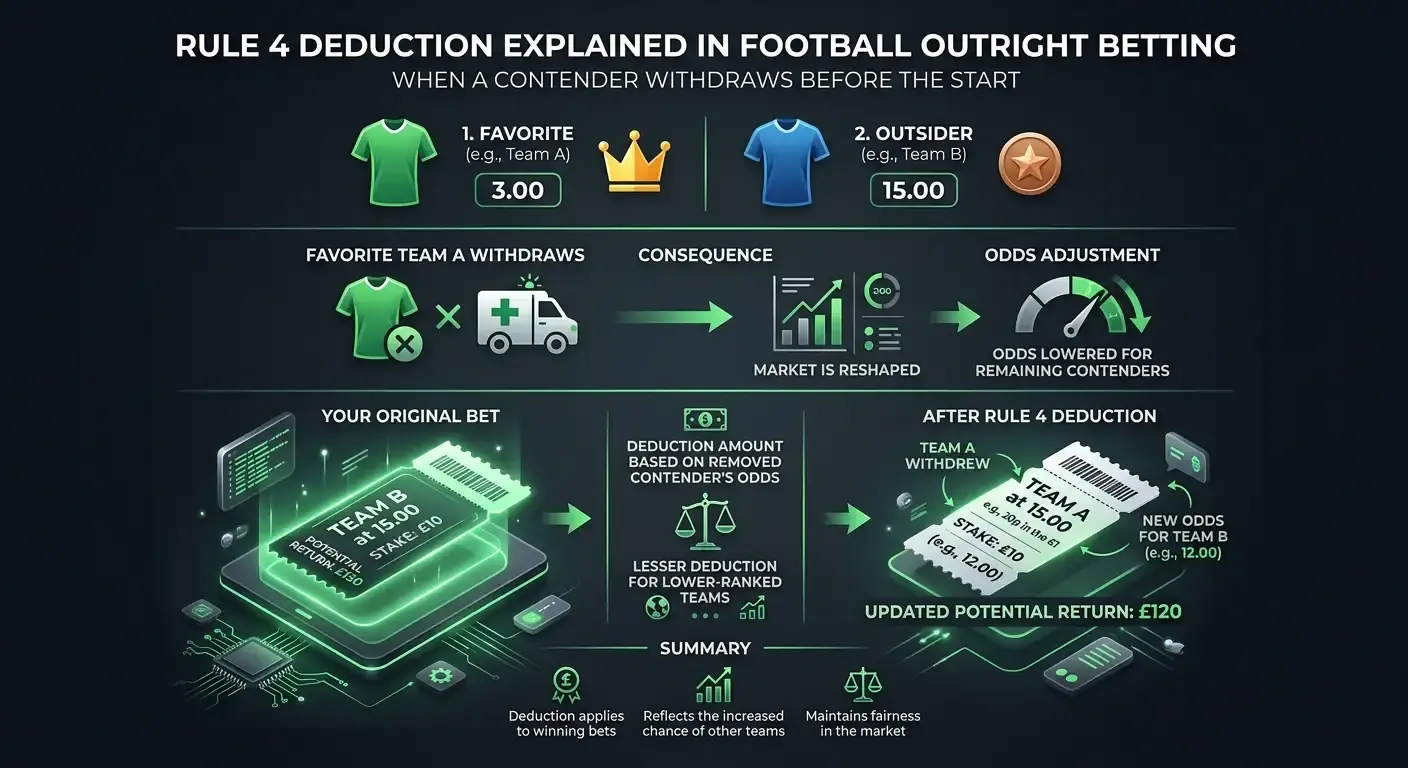
The second is Rule 4, a deduction applied when the field changes after you have placed your bet. If you back a team or player to win an outright market and a major contender is withdrawn before the event, the odds on the remaining selections effectively become too generous, because one of the things they were competing against has gone. Rule 4 corrects for this by applying a proportional deduction to your winnings, scaled to the odds of the withdrawn participant. The shorter the withdrawn favourite’s price, the larger the deduction, because removing a strong contender improves your selection’s chances more.
These rules are not bookmaker trickery, they are logical adjustments to keep a long-range market fair as circumstances change, but they catch out bettors who assume the price they struck is the price they will be paid. A winning outright settled with a Rule 4 deduction pays less than the headline odds suggested, and a voided market returns your stake when you expected a profit. Reading the settlement terms before you commit a stake that may be locked away for months is simply non-negotiable.
Building a disciplined outright approach
My approach to outrights treats them as a small, deliberate part of my betting rather than a core activity, precisely because of the patience and risk involved. I size outright positions modestly, accepting that the stake is locked away and that a single misfortune can end a months-long bet, and I never commit so much to long-range markets that my liquidity for the value bets that appear week to week is compromised. An outright is a long-term seed, not a weekly harvest.

The selections I favour are those where I have a genuine, defensible reason to believe the early price underrates the true chance, and I am ruthless about skipping the markets where I am simply guessing. The relegation and promotion markets often offer clearer value than the title race, because the bottom and middle of a table are harder for the market to model than the elite, and public sentiment lags a developing trajectory there for longer. That lag is the bettor’s friend.
Where outright betting genuinely shines is in combination with the each-way structure, because the large fields and long odds of season-long and tournament markets are exactly what the each-way format was built for. Backing a contender each way, so a strong campaign that falls just short still pays through the place portion, transforms the risk profile of an outright and is often the smarter way to play these markets. My guide to how win and place stakes work covers exactly how to apply that structure to the outright markets where it adds the most value.
